
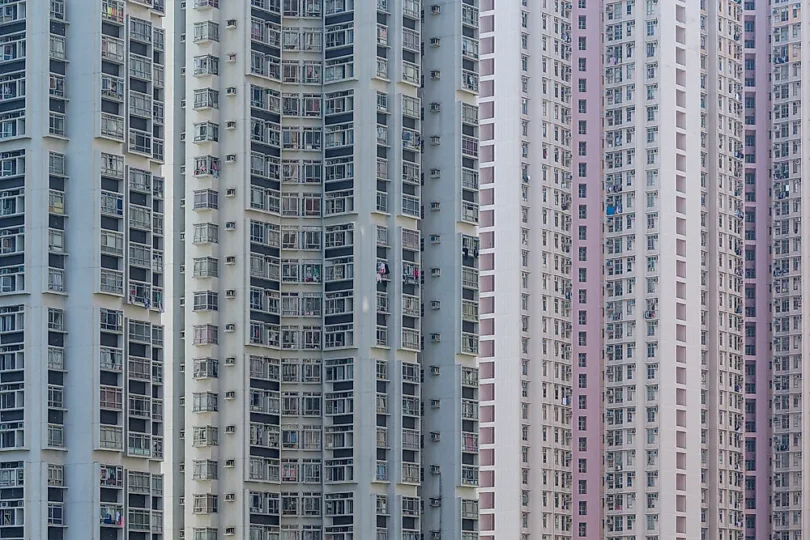
Most of us share a wall with a handful of neighbors and call it a day. The buildings on this list share walls with thousands.
Each one packs the population of a small town behind a single facade, with the shops, schools, and clinics to match, so residents can go weeks without technically needing to leave. We are counting up from merely huge to genuinely staggering. Here are six of the world’s most populated buildings.
6. Ponte City – Johannesburg, South Africa
Ponte City Building at sunset.
Ponte City Building at sunset.
Ponte City is impossible to miss: a 54-story concrete cylinder in the Berea neighborhood of Johannesburg, South Africa, hollow all the way up the middle like a giant chimney. That open shaft, known as the core, was built to funnel daylight into the inward-facing apartments. When it went up in 1975 it was the glamorous address in town, and at 567 feet it is still the tallest residential building in Africa. Then the 1980s and 90s happened: the tower slid into crime and neglect, and the core filled with several stories of accumulated trash before a determined cleanup hauled it back to respectability. Today roughly 3,000 people live inside, beneath what is billed as the largest advertising sign in the southern hemisphere...To Read The Full Content; Tap Here Now .
5. Sillon de Bretagne – Nantes, France
The stepped, pyramidal Sillon de Bretagne building in Saint-Herblain, France.
The stepped Sillon de Bretagne rising over Saint-Herblain, near Nantes, France.
Sillon de Bretagne looks like a concrete staircase built for a giant. The stepped, pyramidal slab sits in Saint-Herblain, just outside Nantes in western France, and stretches an improbable 425 meters (1,394 feet) end to end, which helps make it one of the largest buildings in Europe by sheer volume. At 32 stories and 318 feet tall, it was the tallest residential building in France when it was finished in the early 1970s. Around 3,600 people live and work inside. There is even a radio antenna bolted to the roof, quietly broadcasting a local digital audio signal to the rest of Nantes.
4. Chungking Mansions – Hong Kong
Beautiful view of the Chungking mansions.
Beautiful view of the Chungking mansions.
Chungking Mansions opened in 1961 as a residential block in the dense Kowloon district of Hong Kong, but it long ago turned into something far stranger and more interesting. Its five interconnected towers, 17 stories each and served by just two elevators per block, are now a warren of budget guesthouses, curry houses, phone stalls, and money changers. An estimated 4,000 people live here, and many thousands more pass through, drawn from dozens of countries; one anthropologist famously described it as a hub of “low-end globalization.” All that improvised commerce comes with a catch, as the building carries a long-standing reputation for shaky fire safety.
3. Edificio Copan – Sao Paulo, Brazil
The curving Edificio Copan in Sao Paulo, Brazil.
The wave-like Edificio Copan in downtown Sao Paulo, Brazil.
Edificio Copan ripples across the skyline of Sao Paulo, Brazil, in one long sinuous wave, the unmistakable signature of its architect, Oscar Niemeyer. Begun in 1952 and finished in 1966 after a string of interruptions, the 38-story building holds 1,160 apartments that range from tiny studios to large family units, plus dozens of shops and businesses at street level. About 5,000 people live here, enough that the building was assigned its own postal code. It was designed on purpose to mix residents across Brazil’s social classes under one curving roof.
2. Le Lignon – Geneva, Switzerland
The long Le Lignon apartment complex in Vernier, near Geneva, Switzerland.
Part of the kilometer-long Le Lignon complex in Vernier, near Geneva, Switzerland.
Le Lignon was Switzerland’s answer to a 1960s housing crunch, and the answer was to go big. Built in the Vernier suburb of Geneva, its main block runs close to a kilometer, which makes it one of the longest apartment buildings in Europe. Inside its 2,780 units live more than 6,000 people, along with their own school, shopping center, and church, so a resident really can handle most of daily life without leaving the property. It is less an apartment block than a small town that happens to share one very long address.
1. Regent International – Hangzhou, China
Regent International Center.
Regent International Center.
And then there is Regent International, which makes everything else on this list look downright neighborly. This single S-shaped tower in Hangzhou, China, holds somewhere around 20,000 residents, with room for as many as 30,000, making it the largest apartment building by capacity on the planet. It was designed as a six-star hotel by architect Alicia Loo, who also worked on Singapore’s Marina Bay Sands, before being converted into roughly 5,000 apartments. The 39-story building is a self-contained vertical city: supermarkets, food courts, gyms, swimming pools, salons, internet cafes, even schools and a clinic, all under one roof, with a subway stop at the door. A windowless studio rents for around 1,500 yuan a month, which is why it fills up with students and young workers who, in theory, could go weeks without ever stepping outside. Critics call it dystopian. Its residents mostly call it convenient.
These buildings all answer the same question in their own way: what happens when you stack a whole town on top of itself? The results run the gamut, beloved in some cases and notorious in others, but each one proves that a home does not require a house. Sometimes it just requires knowing which of the several thousand front doors is yours.