
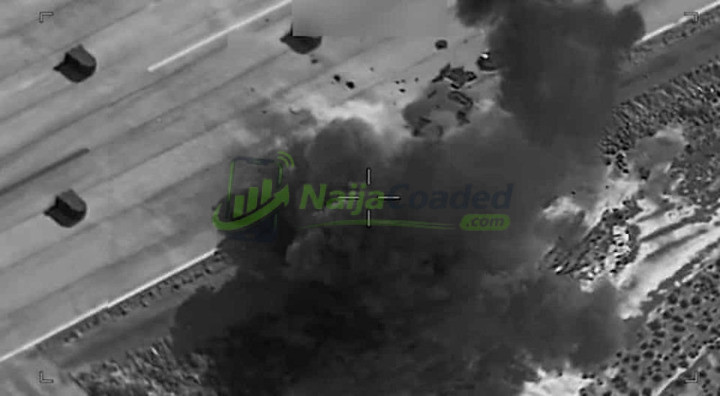
United States Central Command (CENTCOM) has announced that American forces struck more than 170 targets across Iran over two consecutive nights, in what it described as retaliation for Iranian attacks on commercial vessels transiting the Strait of Hormuz, as the fragile ceasefire between the two countries completely collapsed.
CENTCOM said its forces initiated the campaign on Tuesday night, striking over 80 targets including Iranian air defense systems, command and control networks, coastal radar sites, anti-ship missile capabilities, and more than 60 Islamic Revolutionary Guard Corps (IRGC) small boats.
A second, equally intensive wave of bombardments followed on Wednesday night, hitting approximately 90 additional military targets along the Iranian coastline...To Read The Full Content; Tap Here Now .
Local state media reported that explosions rocked the port cities of Chabahar, Konarak, and the strategic naval hub of Bandar Abbas, where several sectors suffered total power grid failures.
“US forces remain postured and prepared to hold Iran accountable when the agreement is not adhered to or obeyed,” CENTCOM wrote on X.
According to Iranian state media, the initial waves of U.S. strikes killed at least eight army and navy personnel. In a swift counter-escalation, the IRGC retaliated by targeting roughly 85 U.S.-linked military facilities across the Persian Gulf, launching waves of drones and missiles that triggered air raid sirens and forced air defense activations across Bahrain and Kuwait.
The initial U.S. intervention was triggered by multi-directional Iranian attacks on three commercial tankers navigating the critical trade corridor: the Marshall Islands-flagged M/T Al Rekayyat, which was carrying Qatari liquid gas; the Saudi Arabia-flagged M/T Wedyan; and the Liberian-flagged M/T Cyprus Prosperity.
CENTCOM labeled the maritime interceptions “unwarranted aggression” and a severe threat to global energy supplies, noting that daily ship transits through the strait plummeted to a fraction of their normal volume.
Speaking to reporters at the NATO summit in Ankara, Turkiye, United States President Donald Trump declared that the memorandum of understanding signed with Iran on June 17 was finished, warning that the U.S. bombing campaign would “get much worse” if shipping disruptions continued.
“We attacked very powerfully last night, the very dangerous people from Iran,” Trump said, adding that while he might allow backchannel communications to continue for now, he considered them “a waste of time” and described Iran’s leadership as “scum.”
Trump further heightened regional anxieties by revealing he had ordered U.S. forces to prepare to heavily target Iran’s primary oil export terminal on Kharg Island, warning that the U.S. could easily “take control” of the facility entirely if necessary.
In lockstep with the military strikes, the United States Treasury Department immediately reimposed heavy sanctions on Iranian oil, abruptly revoking a 60-day waiver that had permitted Tehran to sell crude oil during active peace negotiations.
Global energy and financial markets reacted sharply to the sudden threat of an all-out regional war.