Connect with us

Entertainment

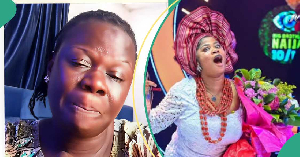
Actress Sarah Martins Hails Seyi Tinubu’s ₦20 Million Donation

Published

on

After a public arrest for her charity work, the Nollywood star receives a life-changing endorsement from the President’s son to secure a permanent shop.

Nollywood actress Sarah Martins described her week as a journey “from disgrace to grace” after receiving a ₦20 million donation for her charity from Seyi Tinubu, the son of President Bola Tinubu.

The transformative gift comes just one day after Martins was arrested by Lagos environmental officials for allegedly violating street vending laws during a public cooking outreach to feed the vulnerable.

An emotional Martins announced the support in a video on Friday, where a representative for Tinubu presented the funds, explaining they were intended for her to secure a proper shop—a move that would legitimize the very activity she was arrested for. The representative added that Tinubu would also fully equip the new space with industrial appliances.

“From the office of the President, our philanthropic youth leader, Mr Seyi Tinubu, just supported my NGO with N20 million,” a grateful Martins said. “He didn’t only give me N20 million. He also promised to take my free food charity outreach to the next level… I am beyond grateful.”

The actress explained that her original motive for cooking on the street was driven by a desire to give hope to those unsure of their next meal. What began as a violation has now turned into a powerful partnership, ensuring her charitable work can continue and expand from a permanent, safe location.

Continue Reading

Entertainment

Federal Government commits 5% of GDP to boost manufacturing

Published

on

The Federal Government has stated that it will channel up to five per cent of Nigeria’s Gross Domestic Product annually into industrial development financing, as it targets a sharp rise in manufacturing contribution to the economy.

The plan is contained in the newly launched Nigeria Industrial Plan, unveiled in Abuja by the Federal Ministry of Industry, Trade and Investment. Under the framework, manufacturing is projected to contribute 15 per cent to GDP by 2030 and 25 per cent by 2035, while mining is expected to rise to eight per cent by 2030 and 10 per cent by 2035.

The policy consolidates fiscal, monetary, export, and industrial measures into a single national framework aimed at accelerating large-scale production, export competitiveness, and job creation.

A key pillar of the plan is aggressive financing. The government said it would recapitalise the Bank of Industry to N3tn by 2026 and expand sector-specific intervention funds, largely domiciled with the Central Bank of Nigeria, to increase long-term capital to priority sectors.

However, the framework did not spell out detailed funding sources and structure.

The government identified four sectors for immediate focus: metals and solid minerals, oil and gas, construction, and manufacturing. Minister of State for Industry, John Enoh, described the policy as a decisive shift in national priorities.

The framework introduced a consolidated incentive structure aligned with the Nigeria Tax Act 2025. It replaces the Pioneer Status Incentive with an Economic Development Incentive that ties tax relief to measurable outcomes such as investment levels, production capacity, and employment generation in priority sectors.

The policy also introduced an Interest Drawback Scheme for Micro, Small, and Medium Enterprises. Instead of upfront subsidised rates, eligible firms will pay commercial interest rates and receive partial refunds after meeting agreed milestones, including job creation and export growth.

Vice President Kashim Shettima stressed that coordination would determine the success of the policy. “As we advance the work of industrialisation, we must be clear-eyed about what it demands. It requires deliberate coherence across energy, trade, infrastructure, finance, skills, and innovation. Above all, it calls for a purposeful partnership between government and the private sector, working in alignment to deliver sustainable, inclusive growth,” Shettima said.

The framework also placed strong emphasis on technology and sustainability. It identifies automation, robotics, and digital manufacturing as central to future operations and calls for expanded research and development in priority sectors.

It set a target of achieving 25 per cent renewable energy usage in the industrial sector by 2030 and aligned industrial expansion with Nigeria’s Energy Transition Plan and net-zero ambition by 2060.

On human capital development, the plan proposed a revamp of Technical and Vocational Education and Training programmes to build a skilled manufacturing workforce. It also sought to harmonise the roles of academia, public institutions, and the private sector to strengthen industrial skills and innovation.

The government said the policy comes at a crucial stage of the African Continental Free Trade Area implementation and aims to position Nigeria as a net exporter of manufactured goods and a regional supply chain hub.

By promoting local production of critical inputs, including active pharmaceutical ingredients, the plan seeks to reduce import dependence and ease foreign exchange pressures.

Backed by a five-year implementation roadmap from 2025 to 2030, the Nigeria Industrial Plan outlines strategic objectives, responsible institutions, and measurable outcomes.

Officials said clearer incentives and expanded financing would reduce investor uncertainty and unlock stalled projects in the near term, while the medium-term outlook includes stronger agro-processing, pharmaceuticals, and downstream petrochemicals, expanded exports, job creation, and poverty reduction.

Continue Reading

Entertainment

‘I can forgive her’- Imisi reflects on her strained relationship with mother

Published

on

In a recent interview, Imisi, the winner of Big Brother Naija Season 10, opened up about her relationship with her mother, sharing a story marked by forgiveness, faith, and cautious optimism.

She described their connection as complex, admitting that reconciliation hasn’t been easy but emphasizing that her Christian faith has guided her toward letting go of past hurts.

“She is my mom, and I’m a woman I understand the sacrifices it takes to raise a child,” Imisi said.

“God willing… I can forgive her. I’ve forgiven people who aren’t even family, so forgiving her is something I can do.”

Although her upbringing lacked warmth at times, Imisi stressed that she holds no grudges.

“Growing up, we weren’t very close. But I don’t bear any ill feelings. She’s doing her thing, and I’m doing mine,” she explained.

When asked what message she would want her mother to hear, she paused thoughtfully.

“Honestly, I’m not sure. Maybe she should strive to be a better person, but she should keep praying God is with her.”

Through her reflections, Imisi demonstrates a delicate mix of honesty and empathy, showing how faith and forgiveness can influence even the most challenging family relationships.

Continue Reading

Trending

Copyright © 2026 Naijacoaded | All Right Reserved | Powered by Naijacoaded.com |