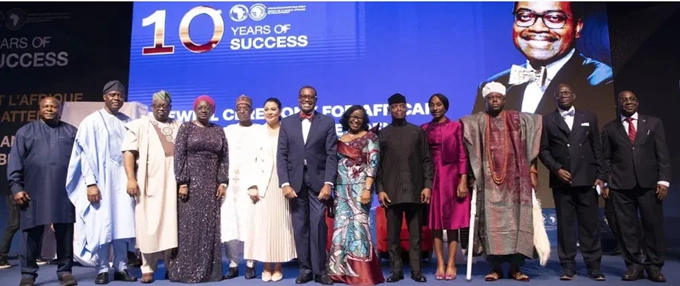
BREAKING NEWS: Did You Miss The 400 $ex T4pe of Equatorial Guinea senior official Baltasar Ebang Engonga? Quickly W4tch! Before They Are deleted Be The First Person To See The Full Videos. Now!The Sofitel Hotel in Abidjan glittered with tributes on Saturday, August 30, as African leaders, development partners, and staff of the African Development Bank (AfDB) gathered to bid farewell to Dr. Akinwumi Adesina, who concluded his 10-year presidency of the continent’s premier development finance institution.
From heads of state to former colleagues, the evening became less of a goodbye and more of a celebration of an era.
Nigeria’s Industry, Trade and Investment Minister, Dr. Doris Nkiruka Uzoka-Anite, representing President Bola Ahmed Tinubu, captured the mood of the moment saying “He has shown us how development is not an abstract concept, but a powerful force that touches and transforms millions of lives.”..READ FULL; FROM THE SOURCE.
She led a high-powered Nigerian delegation, including former Vice President Yemi Osinbajo and governors Seyi Makinde, Caleb Muftwang, and Uba Sani, a testament to the national pride Adesina’s achievements inspire.
From Mission to Legacy
For Adesina, the journey was never about a title. “I came to the Bank with a mission, not to take a job,” he told the gathering in a heartfelt farewell speech that earned him a standing ovation.
That mission, he said, was to make the AfDB “Africa’s most trusted development financier.”
By many accounts, he succeeded. The Bank’s “High 5” strategic priorities—Light Up and Power Africa, Feed Africa, Industrialize Africa, Integrate Africa, and Improve the Quality of Life for Africans—reached an estimated 565 million people over the past decade.
Under his watch, the Bank’s capital base swelled from $93 billion in 2015 to $318 billion in 2024, while maintaining a sterling AAA credit rating.
It also pioneered groundbreaking innovations in development finance, including synthetic securitization and a $750 million private sector hybrid capital transaction.
Building Africa, Brick by Brick
The numbers tell part of the story. Over $102 billion in support for African economies. More than $55 billion poured into infrastructure—power grids, roads, water and sanitation, ports, airports, and digital networks.
But beyond macroeconomic achievements, Adesina’s legacy is etched in institutional reforms and human capital growth.
During his tenure, 236 staff earned promotions, many rising from entry-level to professional ranks. Gender parity advanced significantly, with women now occupying 44% of Vice President roles, compared to 14% a decade ago.
“The Bank’s greatest asset is its people,” Adesina declared, thanking his staff and his wife, Grace, whom he credited as a sounding board for major policy ideas.
A Leader Recognized
Global recognition followed. In 2024, the AfDB was ranked the world’s most transparent financial institution for its sovereign portfolio for the second consecutive year.
Its concessional financing window, the African Development Fund, was ranked second-best globally, ahead of 55 peers in advanced economies.
Adesina’s leadership, according to Osinbajo, was defined not just by crisis response but by foresight: “The success we see now is not just from the last two years, but from the foundation laid a decade ago.”
Passing the Baton
Adesina’s farewell was also a handover. On September 1, 2025, Dr. Sidi Ould Tah takes the helm.
Adesina offered words of assurance: “Leadership may change, but the mission remains. The Bank’s direction is clear, its resolve strong, and its commitment to Africa’s development unshakable.”
And in words that resonated deeply with his audience, Adesina affirmed his enduring identity: “I will live as an African and die as an African, and if at all possible, ask God on the last day to resurrect as an African.”
As the applause lingered, it was clear his decade had left an indelible mark—not only on an institution, but on a continent striving for transformation.BREAKING NEWS: Did You Miss The 400 $ex T4pe of Equatorial Guinea senior official Baltasar Ebang Engonga? Quickly W4tch! Before They Are deleted Be The First Person To See The Full Videos. Now!
Do you want to easily get our latest news fast? kindly follow our Whats-app Channel via this Link Here Now.
Disclaimer: This content, including any advice provided, is for general informational purposes only and should not be considered a substitute for professional medical advice. Always seek guidance from a qualified healthcare professional or your doctor for proper evaluation and treatment. Naijacoaded.com does not accept any responsibility for the use of this information.