
Connect with us

Breaking News

Beans prices fall as farmers debunk “cement preservation” claims, link drop to food market trends

Published

on

The Cowpea and Beans Farmers, Processors, and Marketers Association of Nigeria (C&BFPMAN) has strongly denied allegations that its members use cement to preserve beans.

The clarification comes after a viral video on social media showed some boys mixing beans with what appeared to be cement, sparking public outrage.

How beans are really preserved

Speaking in Lagos, the association’s National President, Kabir Shuaibu, said no legitimate farmer or processor would risk consumer health or market trust with such “harmful and absurd practices.”

“It is common sense that the use of cement for bean preservation would be easily detected, and no consumer will patronise us. We will never engage in such harmful practices,” Shuaibu said.

According to Shuaibu, Nigerian bean farmers now rely on airtight nylon-lined sacks, which prevent insect infestation without harmful additives.

“We stopped using additives some time ago. The beans are packaged in thick nylon bags inside sacks, which make them airtight and safe for long-term storage,” he explained.

He noted that some farmers also use dried peppers or a mild, internationally accepted additive known as Topstoxin to keep away weevils from old stock. The methods, he said, are “safe, cost-effective, and in line with international best practices.”

Prices drop across Nigerian markets

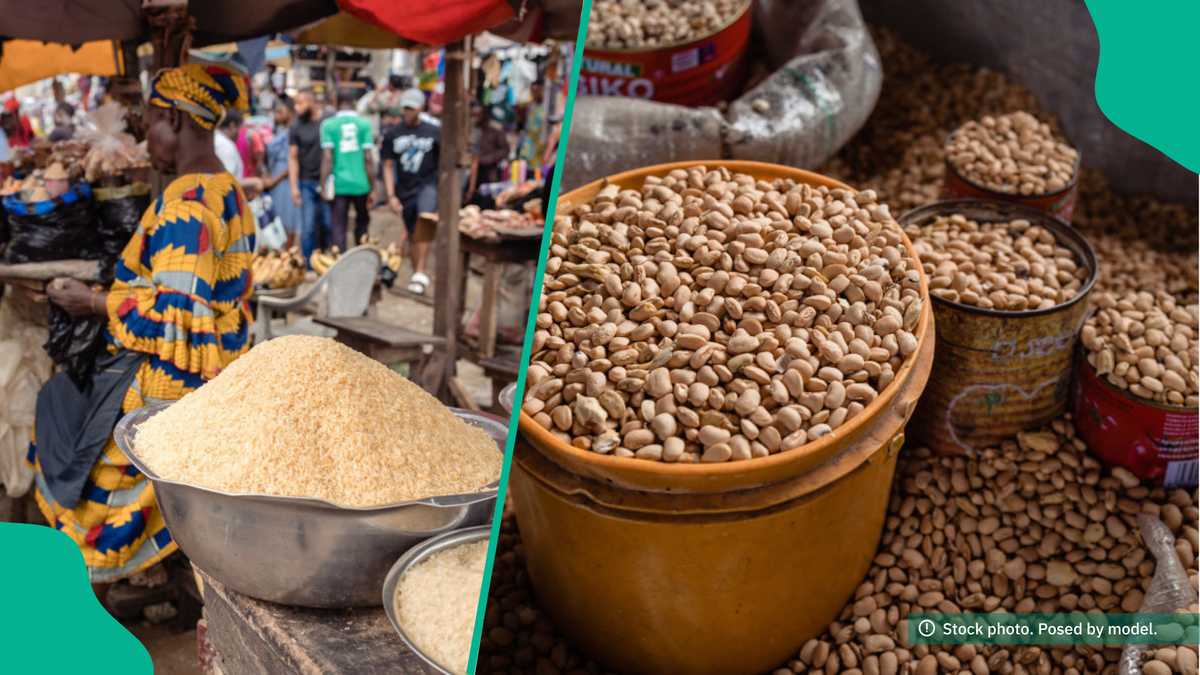
Beyond dispelling the cement-preservation claims, farmers highlighted that bean prices have recently dropped in many Nigerian markets due to good harvests and improved preservation methods.

According to the News Agency of Nigeria, market surveys show that a 100kg bag of beans now sells for between N85,000 and N95,000, down from as high as N120,000 earlier this year.

Traders attribute the fall not only to better supply but also to reduced wastage caused by insect damage.

This comes as part of a broader decline in food prices, especially staples like rice.

The end of government import waivers has stabilised rice markets, with a 50kg bag of local rice now averaging N55,000 to N58,000, compared to N65,000 in July.

Analysts say these combined drops could help cool inflationary pressures on households already stretched by high fuel costs and rising rents.

Building trust in local produce

For farmers, the cement controversy highlighted the urgent need to rebuild public trust in local produce.

“We want Nigerians to know that we take food safety very seriously. Our methods meet international standards, and our goal is to make beans affordable, safe, and export-ready,” Shuaibu said.

With beans and rice leading a wider fall in food prices, consumers may be in for more relief in the coming months—if harvests remain strong and supply chains stable.

Quickly! Watch The Video Before It’s Deleted! |Save Hot 3:00 Minutes $3x V!de0s To Ur Phone Directly | Watch 2:00 H0t $3x V!d0es Now!

Quickly! Watch Before It’s Deleted! Another Popular Nigeria Pastors Wife $leeps With Male Church Member, Husband Engaged In Physical Compact Him. Watch The Full Video Here Now.

Continue Reading

Breaking News

National Pension Commission (PenCom) changes price disclosure rule

Published

on

National Pension Commission (PenCom) has directed Pension Fund Administrators (PFAs) to discontinue the publication of daily unit prices for Retirement Savings Account (RSA) and Retiree Funds on their websites, replacing the requirement with a six-month disclosure of returns based on a three-year rolling average.

The directive was contained in a circular issued by the commission.

Under the new guideline, PFAs must stop implementing Section 2.0 (iv) of the Commission’s March 23, 2013 circular, which required them to display daily unit prices for the last seven days.

Instead, they are to publish on their websites the last six months’ rate of return — calculated as a 36-month compounded rolling average in line with the Circular for the Calculation and Reporting of Rate of Returns by Licensed Pension Fund Operators (LPFOs).

According to the commission, the rate of return must be clearly displayed on the homepage of each PFA’s website.

For instance, the six-month disclosure covering April to September 2025 would reflect the 36-month compounded returns ending in each of those months.

This has however raised transparency concerns in the pension industry.

The 2013 circular on Minimum Information to be displayed on PFA Websites formed part of PenCom’s transparency framework for the Contributory Pension Scheme.

The latest addendum modifies that requirement but does not remove PFAs’ obligation to disclose performance information.

Industry watchers say the development may reignite debate over the balance between long-term investment reporting and real-time transparency in Nigeria’s pension industry.

All enquiries on the addendum, the Commission said, should be directed to its Surveillance Department.

An industry analyst who does not want her name mentioned said the move could reduce contributors’ access to real-time performance data.

She said: “Daily unit prices allowed RSA holders to independently track short-term movements and detect fluctuations in fund valuation.

“With only a three-year rolling average now required, contributors will no longer see recent performance in isolation”, she noted.

The analyst added that while pension funds are long-term vehicles, removing daily disclosure raises concerns about information asymmetry.

“PFAs will still compute daily valuations internally. The issue is whether contributors should be denied access to data that already exists,” the analyst said.

However, another pension expert defended the directive, noting that pensions are structured for long-term accumulation and should be assessed over extended periods.

“A 36-month rolling average smooth’s out short-term volatility and provides a more accurate reflection of sustained performance,” the expert said, warning that excessive focus on daily fluctuations could encourage reactionary fund switching.

Continue Reading

Breaking News

Dollar rises in black market on Monday, traders quote new exchange rate

Published

on

Dollar edges higher against the naira in black market trading Dollar edges higher against the naira in black market trading

The United States dollar at the parallel market increased in value on Monday, Febuary 23 with traders quote at N1,375/$ as the new selling exchange rate.

The new rate is a slight depreciation for the naira when compared to N1,343 a dollar market closed on Friday, February 20, 2026.

Abdulahhi, a forex dealer, told Legit.ng that the new exchange rate follows renew demand in the market.

“I am currently selling dollars at N1,375/$1 and buying at N1,355/$1. The pound is trading at N1,845 to sell and N1,805 to buy, while the euro is also moving steadily in the market.

“It seems this week the dollar will return to over N1,400. I have been getting a lot of request.”

The fall of the naira comes as BDC operators continue to face difficulties in accessing dollars from commercial banks.

BDCs can get dollar

The apex bank had previously issued a circular allowing licensed BDCs to access foreign exchange through authorised dealers at the prevailing market rate.

Under the directive, each BDC is permitted to purchase up to $150,000 weekly, subject to Know Your Customer (KYC) requirements and due diligence checks, Punch reports.

Leadership reported that despite a policy announcement, some operators disclosed that no transactions have been completed under the new arrangement.

A BDC operator, who requested anonymity, said the directive remains largely unimplemented. According to him, the circular provides that disbursements will be made through settlement accounts, a provision that has raised operational concerns.

He questioned the feasibility of seamless, real-time transfers between domiciliary accounts across different banks, noting that such infrastructure may not yet be fully in place.

The operator added that while commercial banks appear supportive of the policy, many are still developing internal processes to align with the CBN’s directive.

He explained that BDCs are required to submit bid orders through their banks, which would then access the market on their behalf.

Naira in the official market

Meanwhile, in the Nigerian Foreign Exchange Market (NAFEM), the naira closed against the US dollar on Friday, February 20 at N1,346.32/$1 from N1,341.35/$1 a day earlier.

At the GTBank FX desk, the naira weakened by N7 against the dollar to quote N1,356/$1.

Continue Reading

Trending

Copyright © 2026 Naijacoaded | All Right Reserved | Powered by Naijacoaded.com |