

Connect with us

Breaking News

BREAKING: Nigeria Union of Petroleum and Natural Gas Workers (NUPENG) Uncovers Dangote’s Underlying Plan Under Free Petrol Distribution

Published

on

Quickly! Watch The Video Before It’s Deleted! |Save Hot 3:00 Minutes $3x V!de0s To Ur Phone Directly | Watch 2:00 H0t $3x V!d0es Now!

Did You Miss The 400 $ex T4pe of Equatorial Guinea senior official Baltasar Ebang Engonga? Quickly W4tch! Before They Are deleted Be The First Person To See The Full Videos. Now!

The Nigeria Union of Petroleum and Natural Gas Workers (NUPENG) has accused Dangote Petroleum Refinery of disguising an anti-union and monopolistic agenda under the cover of a planned free petrol distribution scheme.

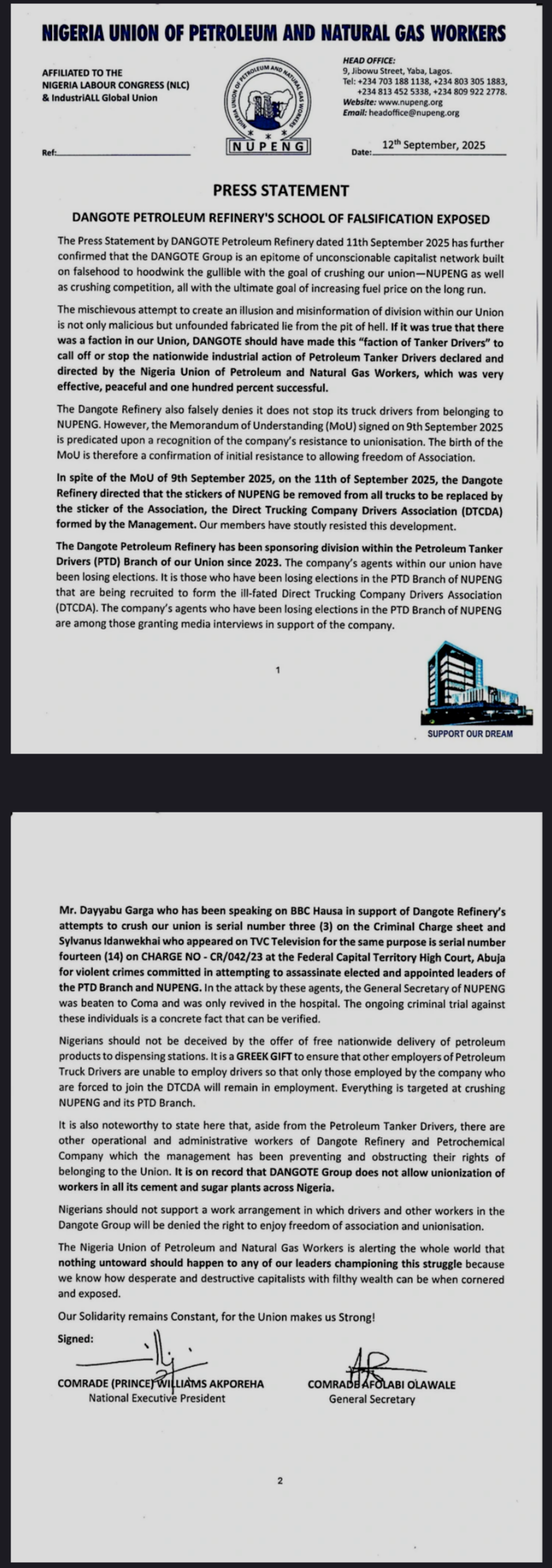
In a statement on Friday signed by National Executive President, Comrade Williams Akporeha, and General Secretary, Comrade Afolabi Olawale, NUPENG alleged that the move by the refinery to deliver free fuel to selected states was a “Greek gift” designed to cripple union activities and eliminate competition in the petroleum trucking sector.

The union’s accusations came after the Dangote Group dismissed claims of anti-labour practices, monopoly tendencies, and planned fuel price hikes. The refinery insisted that allegations it barred tanker drivers from joining NUPENG were “entirely unfounded.”

Earlier in the week, NUPENG had shut down depots, protesting that the refinery had prevented newly recruited drivers of its 4,000 compressed natural gas-powered trucks from joining the union.

The issue was eventually addressed on Tuesday with the government mediating.

However, the union’s National President, Williams Akporeha, on Wednesday said Dangote violated an agreement signed at the office of the Department of State Services (DSS).

According to NUPENG, drivers were allegedly instructed to remove union stickers from their trucks and compelled to load products in defiance of established rules.
Meanwhile, Dangote Petroleum Refinery announced on Thursday night that its free petrol distribution scheme will commence on Monday, beginning in the South-West, the Federal Capital Territory, Kwara, Delta, Rivers, and Edo States. It also slashed pump prices to ₦841 per litre in Lagos and the South-West, and ₦851 in Abuja, Kwara, Edo, Rivers, and Delta.

But NUPENG, in its Friday statement titled “Dangote Petroleum Refinery’s School of Falsification Exposed,” accused the company of using the free distribution as a ploy to dominate the market and silence organised labour.

The union alleged that Dangote had been sponsoring divisions within its Petroleum Tanker Drivers (PTD) branch since 2023, promoting rival groups like the Direct Trucking Company Drivers Association (DTCDA) to weaken NUPENG. It further claimed that some individuals parading as supporters of Dangote were facing criminal trials over violent attacks on union officials, including an attempt on the life of the PTD leadership that left its General Secretary in a coma.

NUPENG maintained that the Memorandum of Understanding signed on September 9 confirmed the refinery’s earlier resistance to unionisation. The union accused the refinery of replacing NUPENG stickers on trucks with those of the newly formed DTCDA, which its members resisted.

The statement also alleged that Dangote Group has consistently denied unionisation rights across its cement and sugar operations nationwide.

“Nigerians should not be deceived by the offer of free nationwide delivery of petroleum products to dispensing stations,” NUPENG warned. “It is a Greek gift meant to wipe out competition and crush our union.”

The union further cautioned that any harm to its leaders would be blamed on what it described as “desperate and destructive capitalists with filthy wealth.”

Quickly! Watch The Video Before It’s Deleted! |Save Hot 3:00 Minutes $3x V!de0s To Ur Phone Directly | Watch 2:00 H0t $3x V!d0es Now!

Did You Miss The 400 $ex T4pe of Equatorial Guinea senior official Baltasar Ebang Engonga? Quickly W4tch! Before They Are deleted Be The First Person To See The Full Videos. Now!


Continue Reading

Breaking News

National Pension Commission (PenCom) changes price disclosure rule

Published

on

National Pension Commission (PenCom) has directed Pension Fund Administrators (PFAs) to discontinue the publication of daily unit prices for Retirement Savings Account (RSA) and Retiree Funds on their websites, replacing the requirement with a six-month disclosure of returns based on a three-year rolling average.

The directive was contained in a circular issued by the commission.

Under the new guideline, PFAs must stop implementing Section 2.0 (iv) of the Commission’s March 23, 2013 circular, which required them to display daily unit prices for the last seven days.

Instead, they are to publish on their websites the last six months’ rate of return — calculated as a 36-month compounded rolling average in line with the Circular for the Calculation and Reporting of Rate of Returns by Licensed Pension Fund Operators (LPFOs).

According to the commission, the rate of return must be clearly displayed on the homepage of each PFA’s website.

For instance, the six-month disclosure covering April to September 2025 would reflect the 36-month compounded returns ending in each of those months.

This has however raised transparency concerns in the pension industry.

The 2013 circular on Minimum Information to be displayed on PFA Websites formed part of PenCom’s transparency framework for the Contributory Pension Scheme.

The latest addendum modifies that requirement but does not remove PFAs’ obligation to disclose performance information.

Industry watchers say the development may reignite debate over the balance between long-term investment reporting and real-time transparency in Nigeria’s pension industry.

All enquiries on the addendum, the Commission said, should be directed to its Surveillance Department.

An industry analyst who does not want her name mentioned said the move could reduce contributors’ access to real-time performance data.

She said: “Daily unit prices allowed RSA holders to independently track short-term movements and detect fluctuations in fund valuation.

“With only a three-year rolling average now required, contributors will no longer see recent performance in isolation”, she noted.

The analyst added that while pension funds are long-term vehicles, removing daily disclosure raises concerns about information asymmetry.

“PFAs will still compute daily valuations internally. The issue is whether contributors should be denied access to data that already exists,” the analyst said.

However, another pension expert defended the directive, noting that pensions are structured for long-term accumulation and should be assessed over extended periods.

“A 36-month rolling average smooth’s out short-term volatility and provides a more accurate reflection of sustained performance,” the expert said, warning that excessive focus on daily fluctuations could encourage reactionary fund switching.

Continue Reading

Breaking News

Dollar rises in black market on Monday, traders quote new exchange rate

Published

on

Dollar edges higher against the naira in black market trading Dollar edges higher against the naira in black market trading

The United States dollar at the parallel market increased in value on Monday, Febuary 23 with traders quote at N1,375/$ as the new selling exchange rate.

The new rate is a slight depreciation for the naira when compared to N1,343 a dollar market closed on Friday, February 20, 2026.

Abdulahhi, a forex dealer, told Legit.ng that the new exchange rate follows renew demand in the market.

“I am currently selling dollars at N1,375/$1 and buying at N1,355/$1. The pound is trading at N1,845 to sell and N1,805 to buy, while the euro is also moving steadily in the market.

“It seems this week the dollar will return to over N1,400. I have been getting a lot of request.”

The fall of the naira comes as BDC operators continue to face difficulties in accessing dollars from commercial banks.

BDCs can get dollar

The apex bank had previously issued a circular allowing licensed BDCs to access foreign exchange through authorised dealers at the prevailing market rate.

Under the directive, each BDC is permitted to purchase up to $150,000 weekly, subject to Know Your Customer (KYC) requirements and due diligence checks, Punch reports.

Leadership reported that despite a policy announcement, some operators disclosed that no transactions have been completed under the new arrangement.

A BDC operator, who requested anonymity, said the directive remains largely unimplemented. According to him, the circular provides that disbursements will be made through settlement accounts, a provision that has raised operational concerns.

He questioned the feasibility of seamless, real-time transfers between domiciliary accounts across different banks, noting that such infrastructure may not yet be fully in place.

The operator added that while commercial banks appear supportive of the policy, many are still developing internal processes to align with the CBN’s directive.

He explained that BDCs are required to submit bid orders through their banks, which would then access the market on their behalf.

Naira in the official market

Meanwhile, in the Nigerian Foreign Exchange Market (NAFEM), the naira closed against the US dollar on Friday, February 20 at N1,346.32/$1 from N1,341.35/$1 a day earlier.

At the GTBank FX desk, the naira weakened by N7 against the dollar to quote N1,356/$1.

Continue Reading

Trending

Copyright © 2026 Naijacoaded | All Right Reserved | Powered by Naijacoaded.com |