
Quickly! Watch The Video Before It’s Deleted! |Save Hot 3:00 Minutes $3x V!de0s To Ur Phone Directly | Watch 2:00 H0t $3x V!d0es Now!
INDEED STRANGE THINGS ARE REALLY HAPPENING! Man K!lls His Wife And Her Lover Then Surrenders to Police With Their Severed Heads. Watch The Full Video Before It’s Deleted.
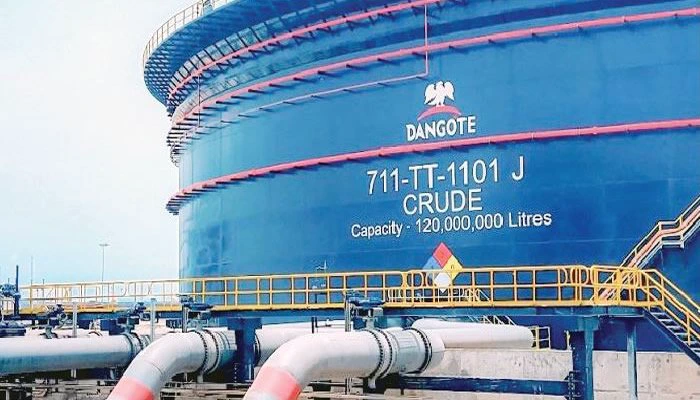
The Dangote Petroleum Refinery will today (Monday) roll out over 1,000 Compressed Natural Gas-powered trucks to begin the first phase of its direct fuel distribution scheme. Consequently, the Independent Petroleum Marketers Association of Nigeria has said it is ready to receive Dangote trucks at its various stations...READ FULL; FROM THE SOURCE.
Officials at the Dangote refinery told The PUNCH that the direct distribution would begin as part of activities marking one year since the refinery started petrol production. Initially scheduled to commence on August 15, the scheme was delayed due to logistics problems in China.
4,000 CNG trucks were ordered from China to be delivered in Lagos for Dangote’s direct fuel distribution. However, the plan could not materialise because there were not enough ships to bring the trucks to Nigeria from China.
A senior official of the Dangote Group told our correspondent that over 1,000 trucks were received before the end of August, and others were coming in hundreds weekly. “The trucks are arriving in hundreds every week,” the official, who spoke in confidence, due to the lack of authorisation to speak on the matter, said.
With the available trucks, the company said it would roll out the logistics-free distribution programme this Monday to significantly reduce fuel prices across Nigeria. From today, the initiative will see the gantry price of petrol reduced to N820 per litre, with corresponding lower pump prices in several key states.
Lagos and other South-Western states will see fuel retailing at N841 per litre, while Abuja, Rivers, Delta, Edo, and Kwara states will sell at N851 per litre. “The first phase of the deployment will cover the Federal Capital Territory, Lagos, Kwara, Delta, Edo, Rivers, and South-West states, with nationwide expansion planned as additional trucks are delivered,” the Dangote Group said in a statement.
It added that the transition to CNG-powered transportation is expected to save the Nigerian economy over N1.8tn annually, saying the move is designed to cut fuel distribution costs, reduce pump prices, and ease inflationary pressures.
Marketers align
Meanwhile, members of IPMAN have said they are ready to receive Dangote trucks in their filling stations.
The IPMAN National President, Abubakar Shettima, confirmed to our correspondent on Sunday that many independent marketers had applied for Dangote’s direct fuel delivery to their retail outlets.
“We are on standby, waiting for Dangote trucks to come. There are many of our members who have applied to get direct fuel delivery. The registration is done online by individual marketers. We are expecting the trucks to come tomorrow, by God’s grace,” Shettima said.
On the price reduction, the IPMAN president said it would make the masses happy, and that was what IPMAN stands for. “The price reduction is good; it’s okay. We are going to start with the price he said he will give us, because all that we are after is the masses. If the masses are happy, then we don’t have any problem,” he stated.
To those who described the distribution scheme and the price reduction as a Greek gift, Shettima replied, “We are in Nigeria together. When he starts, people will see what is really going on. We are in Nigeria. So, we will wait for the outcome.”
The Depot and Petroleum Product Marketers Association of Nigeria on Saturday described the Dangote gestures as a Greek gift. While kicking against the planned slashing of prices on Monday, DAPPMAN said it was a ploy to stifle competition.
In an interview with our correspondent, the DAPPMAN Executive Secretary, Olufemi Adewole, told Sunday PUNCH that members of the group bought Dangote’s petrol from international traders in Lome, Togo, at prices lower than what was offered locally by the refinery.
He said Dangote sells petrol to international traders at N65 cheaper than the rate it sells the product to local offtakers. But the Dangote refinery downplayed the allegations, suggesting DAPPMAN might be the force behind the recent attack against it by the Nigerian Union of Petroleum and Natural Gas Workers.
NUPENG had accused the refinery of anti-union practices, including refusing to allow drivers to join the group. The union embarked on industrial action over the matter, but this was suspended after the intervention of the Federal Government.
According to DAPPMAN, the price slash was announced because cargoes were at sea, bringing fuel to Nigeria. However, a Dangote spokesman said no amount of falsehoods would stop the fuel distribution scheme scheduled for today. From 4,000, the group said the trucks would hit 10,000 this year.
The company accused NIPCO, a major CNG supplier, of hiking the price so that the scheme would fail. “We at Dangote Group have embarked on a large-scale CNG-powered truck roll-out to boost our logistic strength and cost reductions across the distribution value chain of the domestic economy.
“Even though we recently noticed how the CNG prices doubled a week ago, that will not deter our 10,000 CNG truck roll-out this year. It appears NIPCO, the major player in the CNG business in Nigeria, was targeting our CNG-powered trucking ambition to fail,” the company said in a statement.
NIPCO declined to comment when contacted by our correspondent.
Speaking on its contribution to the economy, Dangote stressed that fuel scarcity has become a thing of the past, with stabilised prices for petrol, diesel, and cooking gas bringing relief to industries, transporters, and households.
“While substandard imports persist in the market, we remain committed to delivering high-quality, locally refined products through trusted partners. Our operations have created over 570,000 direct and indirect jobs, spurring community development through new road networks, power supply, and water infrastructure.
“The refinery also serves as a centre for skills transfer and technology advancement, providing practical training to thousands of Nigerian engineers and technicians. As for claims of monopoly, we reject these as recycled falsehoods,” it stated.
Dangote said the fuel distribution scheme is expected to benefit more than 42 million micro, small, and medium enterprises by lowering energy costs and improving profit margins.
“Dangote Group is investing over N720bn into the programme, which is also anticipated to revitalise dormant filling stations across the country. The project is expected to create numerous direct employment opportunities, including roles for truck drivers, filling station managers, and fuel attendants,” it was said.
The company called on stakeholders, including fuel station operators, telecommunications companies, and large-scale fuel consumers, to partner with the initiative to ensure its success and maximise its economic impact.
Quickly! Watch The Video Before It’s Deleted! |Save Hot 3:00 Minutes $3x V!de0s To Ur Phone Directly | Watch 2:00 H0t $3x V!d0es Now!
INDEED STRANGE THINGS ARE REALLY HAPPENING! Man K!lls His Wife And Her Lover Then Surrenders to Police With Their Severed Heads. Watch The Full Video Before It’s Deleted.
FOR MORE INFO, FINALIZE & FINISH YOUR READING HERE
Do you want to easily get our latest news fast? kindly follow our Whats-app Channel via this Link Here Now.
Disclaimer: This content, including any advice provided, is for general informational purposes only and should not be considered a substitute for professional medical advice. Always seek guidance from a qualified healthcare professional or your doctor for proper evaluation and treatment. Naijacoaded.com does not accept any responsibility for the use of this information.