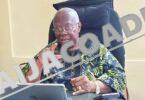
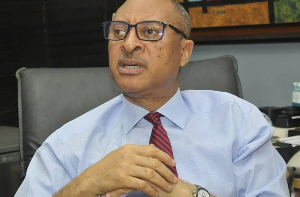
Former presidential candidate of the African Democratic Congress and Chief Convener of the Big Tent Coalition Shadow Government, Prof Pat Utomi, tells AYOOLA OLASUPO about the country’s key challenges, his 70th birthday celebration, and the declining values and public trust in the country..READ FULL; FROM THE SOURCE.
You have spent decades advocating good governance in Nigeria. What would you say is the biggest obstacle to Nigeria’s development today?
It’s a little bit of leadership and an institutional problem. By the way, I wrote a book about why nations are poor, and there were a number of sets of variables that affected each other, which explain performance.
One of them is institutions. Most of the writings of economists, historians, and others in recent times have focused mainly on the role of institutions in economic performance and national development.
Another one is human capital. If you don’t have the right human capital mix, you cannot advance, and then entrepreneurship. If people are not creating wealth, then poverty will persist.
Another one is policy choices. The kind of policy decisions you make will determine whether you move forward or not. If you make decisions that leave you at home and entrapped, you will not make progress.
Then, there is culture because values shape human progress. The most important thing that leaders do is set the tone of the culture. That’s why if you don’t look at the character of people who become leaders, then you make a major mistake that can haunt you for a long time.
Many will say that Nigerians are part of the problem facing the country for refusing to take action when their leaders churn out anti-people policies. What is your opinion about that?
I think that maybe people get accused unfairly sometimes, because I’ve seen people rise. When we were younger, anytime anything went wrong, we were on the streets protesting.
In 1976, when Murtala Muhammed was killed, and it was our perception that he was the leader who would do things in people’s favour, he was so strong that before we even knew that the coup had failed, we were on the streets protesting against the coup.
My life of activism was shaped as a student because we were the Aluta voice. Increasingly, that commitment to fight for good has diminished from several points of view. One is education. Most young people today are not as educated as we were on issues. From age 13, I read Time Magazine and later Newswatch every week, from cover to cover, so I knew what was happening in the world. I knew how the world reacted to issues.
Today, how many young people do that? We read books. We used to compete when I was at Loyola College about how many novels we had read in a week. That developed young students to go against things we believed were wrong. They’ve not had as much of that kind of education we had at that time.
But to be fair to young Nigerians, when they have tried to protest, the system has been enormously cruel, and civilians are much worse than soldiers. I demonstrated during the military regime, and the worst we expected would happen was tear gas.
There was this case of a student, Kunle Adepeju. He was killed by the police in Ibadan, and the demonstration continued every year, even for several years. I remember that we had a big demonstration in 1974 over that same killing of Adepeju.
So, today, they don’t come with tear gas. They come to kill because they are ready to kill. From my house here on the decking, you can see the tollgate. I watched with my two eyes as they were shooting at the Lekki Tollgate, and there has been no consequence for politicians who ordered young people to be shot. I think these are some of the things we have to deal with.
We may have to go back, even if it’s 20 years later, to prosecute political leaders who ordered unjust killings and try them at the International Criminal Court.
With your explanation, do you see poverty as another contributing factor to the youths’ lacklustre attitude towards carrying out demonstrations?
Yes, poverty to a limited extent; there is a weaponisation of poverty, and people are so desperate that protest is not even their top business. They just want to eat the next meal. That may be true. But even that should make people more desperate to come out to protest.
Somehow, politicians have a way of manipulating identity. This weaponisation of identity by politicians has been a terrible thing for Nigerians. That’s really where the problem is. Poverty, yes, because there is some weaponisation of it, but not so much.
You just clocked 70 years. What does that mean to you?
Some people will say he’s been around for 90 years because we’ve known him for a long time (Laughs). It’s an opportunity to give thanks to God because I didn’t expect to make it to 70. Before, I was limited by the fact that my father passed away at 52. So, I was very sensitive, even though the real meaning of my name, Utomi, means long life.
But we are in a situation where my father didn’t live a long life. He died at 52, and it was cancer, so that made me not think in depth for a very long time. It gives me hope. So, at 70 years, for me, is an opportunity for much thanksgiving to God. It is also a very remarkable thing in this sense.
The other thing is that I’ve had a chance to re-evaluate many things. Oftentimes, when people ask if you have to do things over, can you do them differently? Many people will say, ‘No, I will do the same thing.’ But I used to say I would do everything differently because I believe there is no perfection.
Obviously, you learn about what you have done and find that there is probably a better way to do it. But being able to reflect on ideas that I have thought about, I found that there are many ways I could have thought differently. For example, we were the people who actually supported the idea of the Structural Adjustment Programme because the Nigerian economy had reached a point where it was really locked in. It was a trap.
Do you still have the strength to embark on a street protest against bad governance?
I can do anything. I’m probably going to be in Abuja this week to join them at the National Assembly. A few days ago, we had a press conference on this National Assembly matter in Lagos. So, if they are still protesting, I will show up there.
You have previously served as a Special Adviser to Nigeria’s former President. From that insider experience, what major governance mistake do you think Nigerian leaders repeatedly make when managing the economy?
The truth of the matter is that discipline is a very critical part of how you make progress in managing the economy. Our leaders don’t have discipline. For example, it would be very unlikely for you to see me do a budget analysis. Many years ago, I decided that Nigerians don’t even understand what it means to do a budget.
Nigerian leaders just follow a routine. One of my illustrations is a governor who decides to paint the Government House, and he paints it yellow. Then he’s just going down the streets, and somebody says to him, ‘Excellency, I see that you are now favouring MTN, this one that you have painted the Government House.’ Then he says, ‘Hey! Is that MTN?’
Then he goes and orders them to paint it green and says, ‘Oh! That is Glo, change it to red.’ Meanwhile, he didn’t budget for painting the Government House at all. But they have changed the colour many times in one year. So, where did the money come from?
Having worked as Chief Operating Officer of Volkswagen Nigeria, what lessons from the private sector do you believe the government must urgently adopt to improve efficiency and attract serious investment into Nigeria?
The motor industry in Nigeria failed because we didn’t have a national strategy. There are some people who, when they look for how to abuse me, can’t find it. They will now say, ‘So, what happened to Volkswagen?’ Did I do anything that caused it? If it were my fault, how come all of the plants died, the likes of Mercedes and so on?
Then it can’t be that all of them were as stupid as Pat Utomi. We didn’t have a clear national strategy. So, the interesting thing for me personally was that as a graduate student in International Political Economy, I was a huge critic of the import substitution industrialisation strategy, which is the strategy that we used to go into these assembly plants.
When they offered me the job, I said I didn’t want it. If you read my book, ‘To Serve is to Live’, I talked about how I was ‘white-mailed’ into taking the job, not ‘blackmailed’. A wonderful man called Folusho Longe. He was the one in Human Resource Management for Volkswagen. He said to me, ‘Look at you. You are freelancing your way through life. There is no big company in your CV. Even if it’s just to put it in your CV that you worked for a big company, why don’t you just go there for a year or two?’
That was how I went to Volkswagen because I was fundamentally opposed to the import substitution strategy, and that was what he said to me, which was quite thoughtful. He said, ‘Okay, if you don’t like their strategy, if you go there, maybe you’ll be the one who will change the strategy.’ And I said, ‘Fine’. So, I agreed to go and talk to the MD.
I got there. After talking to the MD, he said I had officially started working that same day and that I should move to the office opposite his office. That was how I ended up at Volkswagen, but the bottom line is that when we chose the import substitution industrialisation strategy, we didn’t have the discipline to do the other things that would have turned it into a national industry and sustained it.
You have been vocal about economic reforms. What is your honest assessment of Nigeria’s current economic direction under the present administration?
First and foremost, one of my biggest disappointments with Bola Tinubu is that I thought he was politically savvy enough. They are all divided. So, any real mass leadership will find ways of trying to unite the elite and focus on one direction.
But when you begin to express triumphalism, even when it’s clear you didn’t win the election, then the likelihood that you will make progress is slim. That was my first major shock. It affects development; it doesn’t matter what policies you put in place.
The second one is that the policies in place today are too anxious to please Washington and Paris, and because of that, they don’t think independently enough about consequences. I told you about my reflection on SAP. It’s the same thing that they were offering at SAP that they are offering now, and they are swallowing it hook, line, and sinker.
I’ll give you an example. All the talks about tax and tax-to-GDP ratio; it is logical to say that Nigeria’s tax-to-GDP ratio is very low. But the guys who are giving you the tax-to-GDP ratio, in their countries, how many people are running their own local governments?
In Nigeria, you provide your water, electricity, waste disposal — everything. Those people over there pay taxes, and all those things get done. In Nigeria, none of those things get done, and there is nothing to say that if you pay your taxes, they will be done, because your tax money will be wasted.
As you can see, President Bola Tinubu is not showing a good example. He’s buying a new presidential jet, buying this funny-looking car, and all kinds of things — very wasteful expenditure of money. Taxation and representation go together because the essence of a tax relationship is accountability.
So, if people pay higher taxes, they have to hold people accountable. You can’t have an overspending government talking about taxes. So, you jump at it. Washington says the tax ratio is low, so it’s time to collect taxes. In a completely different view, similar to killing our educational system, that’s what we did because we listened to Washington.
If you were allowed to advise the President directly today, what three urgent economic decisions would you recommend?
It’s inappropriate right now. The first one is already flawed. The first one is to try to bring the elite together.
Nigeria cannot be more divided than it is today, and he has contributed to it very deeply. This division makes progress difficult. Everything else falls. So, they have to rethink the strategy of bringing people together — unite Nigerian people for a common purpose.
You once contested for the presidency. Looking back, do you believe Nigeria is truly ready for visionary leadership, or is the political system designed to frustrate it?
Nigeria has always been ready for leadership. The problem is that the leaders have not quite come out of the way. If you offer leadership, people follow. Let’s just take the time Mahathir Mohamed came a few months ago; people showed themselves completely amenable to leadership.
When Buhari was elected, people had expectations that he was a corruption fighter. After a few months, they found out that all those around Buhari were champions of bribery. So, everybody started, and the whole thing collapsed. We need a good leader, and the people will follow.
Do you still have the ambition to run for the presidency in the near future?
I’m 70 years old. My view is that anybody over 70 should not run for elected office. The presidency is not a geriatric home where public money can be spent on the president’s hospital bill. I might look strong, but the truth is that we have to have objective ways of saying at a certain stage, maybe or maybe not.
Many Nigerians believe elections do not reflect the people’s will. What reforms do you think can genuinely restore trust in Nigeria’s electoral process?
Everything needs to rest on that subject, and it’s not only the 2023 election. Almost every election since 1999 has been bad. I participated as a candidate in 2007. I recall meeting with former US Secretary of State, Madeleine Albright, and former Canadian Prime Minister Martin, who were in the delegation of election observers.
They thought the election was a complete farce, and we continue to mock ourselves. We don’t know that the world mocks us. We pretend. We go and carry out a civilian coup. And when you’ve had an exercise that people say is flawed, what you must do is a review. What went wrong? Has anybody in this government talked about 2023 when the whole world knows something went wrong?
Many governors have defected to the ruling All Progressives Congress. Do you think anything different will happen in 2027?
I think it’s God working for us. By the time they all pack themselves together in one boat, God will just sink the boat, and all of them will go (laughs). I truly believe that when they have finally entered the APC, then the election will be the people versus the APC. If all the people face APC politicians, then it’s not going to amount to anything.
Do you want to easily get our latest news fast? kindly follow our Whats-app Channel via this Link Here Now.
Copyright 2026 Naijacoaded. All rights reserved. This material, and other digital content on this website, may not be reproduced, published, broadcast, rewritten or redistributed in whole or in part without prior express written permission from Naijacoaded.