
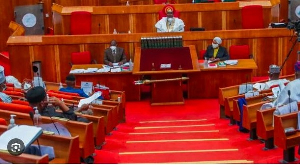
Controversy over a new Electoral Act ahead of the 2027 elections deepened yesterday, as notable activists under the auspices of Movement for Credible Elections (MCE) condemned, in strong terms, the decision of the Senate to remove mandatory electronic transmission of election results as proposed by the Electoral Act Amendment Bill 2026...READ FULL; FROM THE SOURCE.
The body subsequently called on the Senate to immediately reinstate and pass the mandatory electronic transmission of results in the bill, as well as publicly account for those members who opposed the clause.
Leaders of the Steering Council of the newly launched MCE include Dr. Usman Bugaje, Prof Pat Utomi, Comrade Ayuba Wabba, Dr Oby Ezekwesili, Mr Femi Falana, SAN, Ambassador Nkoyo Toyo, Hajia (Dr) Bilikisu Magoro, Comrade Ene Obi, Comrade Salisu Mohammed, and Comrade Bala Zakka.
This happened on a day Senate President Godswill Akpabio said the National Assembly will not be intimidated over a new Electoral Act.
In a statement, yesterday, in Abuja, by MCE Media Coordinator, Comrade James Ezema, the group described the Senate action as a deliberate sabotage against the aspirations of Nigerians.
According to the platform, the transmission process is a minimum safeguard against result tampering, ballot rewriting, and post-election fraud.
The statement reads:”A newly launched coalition of groups of leading political activists in Nigeria, Movement for Credible Elections (MCE), categorically rejects the decision of the National Assembly through the Senate to remove and refuse the mandatory electronic transmission of election results as proposed by the Electoral Act Amendment Bill 2026.
“The action of the lawmakers is considered by MCE as a direct attempt by the National Assembly to subvert the right of Nigerians to freely choose their leaders. By rejecting the mandatory transmission of election results from the polling units and other critical clauses, the National Assembly has chosen opacity over transparency, manipulation over credibility, and elite conspiracy over the sovereign will of the people.
“This is not lawmaking, it is deliberate democratic sabotage against the aspiration of the people of our country, as mandatory electronic transmission of results is not controversial. It is a minimum safeguard against result tampering, ballot rewriting, and post-election fraud. Any legislature that blocks it is openly defending a system that thrives on electoral corruption, stolen mandates and manufactured elections.
“MCE therefore wishes to make it clear that there is no acceptable justification for rejecting mandatory transmission except for the fear of the genuine votes and mandate of the electorate.
“What this means to many who have come together under the banner of this new coalition is that the status quo, where results are vulnerable to manipulation between polling units and collation centres will remain and be exploited in 2027. If we fail to provide the transparency desired by Nigerians, apathy will grow, and this, in turn, will undermine public confidence in elections, with citizens choosing to express their votes in other ways.
“Not only has the failure of transparent election outcomes rewarded impunity and electoral fraud, it has also enabled the courts to become the tool of mandate purchase by the highest bidders and appendage of the executive.
“Whereas elite state capture has become the order of the day in Nigeria, where impunity and oppression reign, this anti-democratic action of the lawmakers shows an unwillingness to submit themselves to transparent competition in a desperate bid to be beneficiaries of the corrupt systems enthroned since 1999.
“This decision confirms what Nigerians already know, that the Nigerian political class is afraid of technological transparency because it exposes their shady and corrupt dealings during elections.
“By this medium, we are calling on our teaming partners and allies not to accept any attempt to rollback the planned Occupy NASS mass protest but to mobilize and proceed peacefully on a mass civic action to defend the popular yearnings of Nigerians in resisting any attempt to return Nigeria to the dark days of manual manipulation and backroom results arising from the distortions occasioned by glitches and interferences with the will of the electorate.
“Again, as we converge in Lagos on Monday, 9th February, as earlier scheduled to address the world on the consequences of another rigged election in Nigeria, we call on Nigerians everywhere, students, workers, traders, professionals, women, youth, community leaders, the media, and the international community to stand up and speak out and be counted in the emergency Occupy NASS mass protests holding in Abuja.’’
We will not be intimidated – Akpabio
Meanwhile, Senate President Akpabio said the Senate will not be intimidated but will do what is right to give Nigerians an Electoral Act that advances democracy.
Akpabio noted this during the public presentation of a book titled, ‘The Burden of Legislators in Nigeria,’ written by Senator Effiong Bob at the NAF Centre, Abuja, yesterday.
He explained that the uproar over Section 60 (3) of the Electoral Act was unnecessary because the amendment process was ongoing.
Akpabio said: “We have not passed the votes and proceedings, there is still harmonization but people are already on television sitting on panels abusing the Senate for something that is yet to be completed.
“We have not completed it until we look at the votes and proceedings. When we bring out the votes and proceedings, any Senator has the right to rise to amend it.
“We can amend anything before we approve the votes and proceedings. Why abuse the Senate when what we have is incomplete?
“I can’t talk until they tell me to drop the gavel. In this case, we are yet to complete the process. Why are people setting up panels on TV stations and abusing us? I leave them to God.”
In a veiled reference to comments made on television by the Chief Executive of the Policy and Legal Advocacy Centre, PLAC, Clement Nwankwo, over the controversy, Akpabio said: “We will not be intimidated. We will do what is right for Nigeria and not that of one NGO. Retreats are not law-making.
“Why do you think that the paper you agree to in Lagos must be approved? I must state clearly that there is no fog or mist in the insinuations.”
Plenary
While explaining what happened during plenary, the Senate President said: “All we said is remove the words ‘Real-time’ to allow INEC decide the mode of transmission. If you make it mandatory and the system fails, there will be a catastrophe.
“So, the door is still open for ADC, APP and any other to make adjustments. There is a conference committee, which reviews the votes and proceedings before the amendment is passed.
“Real-time means that there will be no election results in nine states where there is no network, or any part of the country where there is a grid breakdown, which means there is no election.
“Technology must save and not endanger democracy. You put real time in law when you don’t even have electricity in your community.”
Ahead of 2027 general elections, the National Assembly has been finalizing amendments to the Electoral Act Amendment Bill 2026, a law meant to update the legal framework governing the 2027 general elections.
One of the most contentious issues in the bill has been Clause 60(3), which deals with how election results from polling units are transmitted and reported.
Civil society groups, political actors, and many Nigerians have called for the clause to be amended to mandate the electronic transmission of results in real time directly from polling units to the Independent National Electoral Commission’s Result Viewing (IReV) portal, to curb manipulation and strengthen transparency.
However, when the bill got to the Senate floor for its third reading last week, debates focused intensely on this issue.
Do you want to easily get our latest news fast? kindly follow our Whats-app Channel via this Link Here Now.
Copyright 2026 Naijacoaded. All rights reserved. This material, and other digital content on this website, may not be reproduced, published, broadcast, rewritten or redistributed in whole or in part without prior express written permission from Naijacoaded.