In a statement on Sunday, September 14, 2025, the state police command claimed its operatives arrested Bello for unlawful possession of a firearm, impersonation, and being in possession of fake documents...READ FULL; FROM THE SOURCE.
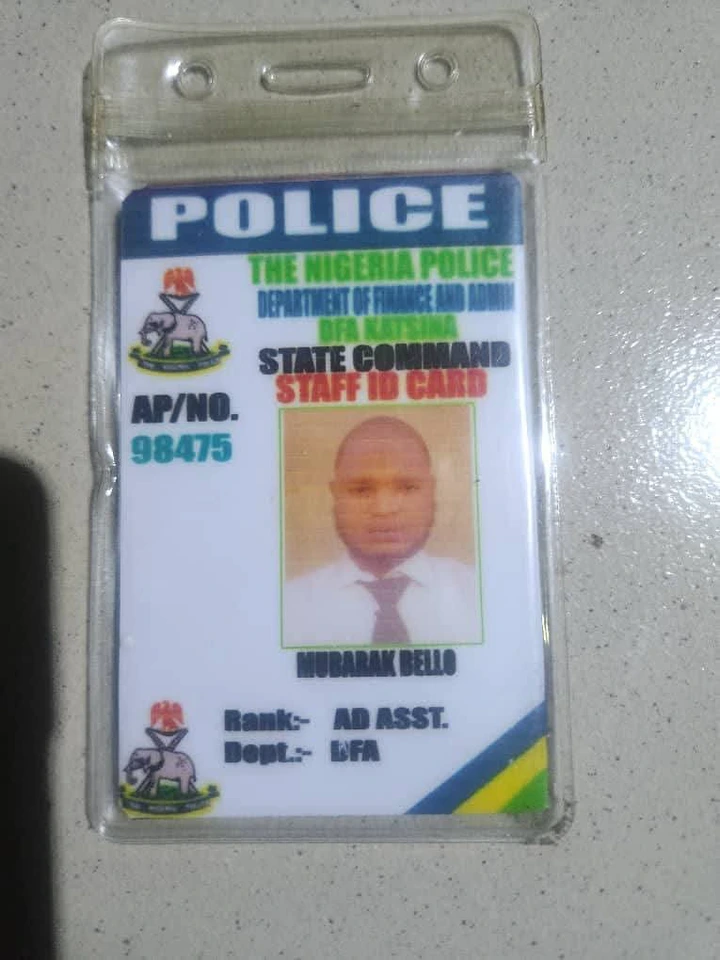
Mubarak Bello, a 38-year-old whistleblower, was arrested by the Katsina State police command on September 13, 2025, and accused of impersonation, possessing a fake police identity card, and unlawful possession of firearms.
In a statement on Sunday, September 14, 2025, the state police command claimed its operatives arrested Bello for unlawful possession of a firearm, impersonation, and being in possession of fake documents.
According to the police statement, the suspect, said to be a resident of Kofar Yamma quarters in Kurfi Local Government Area of Katsina State, was nabbed around 2:30 a.m. on Saturday during a routine patrol by operatives attached to the Command’s Department of Operations.
The command’s spokesman, DSP Abubakar Sadiq Aliyu, said Bello was driving an ash-coloured Toyota Corolla with Lagos registration number GGE 473 BH when the patrol team intercepted him.
ICIR Investigation Points to Victimisation
However, an investigation done by The ICIR has revealed that Bello’s arrest was an act of victimisation for exposing a ghost worker scheme in the police payroll.
The report disclosed that Bello ran a modest business centre inside the Katsina State police headquarters complex, where he handled many secretarial jobs, including typing documents, processing loan applications, and promotion letters for the command.
Exposing Ghost Worker Racket
According to the report, as far back as 2021, Bello exposed a ghost workers’ scheme in the Katsina State police payroll when he petitioned the Economic and Financial Crimes Commission (EFCC) and the Independent Corrupt Practices and Other Related Offences Commission (ICPC).
He provided detailed information about the alleged fraud, which he said he uncovered while operating a business centre at the State Police headquarters.
When his complaints to the two anti-graft agencies yielded no results, Bello escalated the matter to the Office of the Attorney General of the Federation and Minister of Justice.
The report noted that documents and petitions he filed over the years, some of which were reviewed by The ICIR, show that Bello repeatedly sought intervention from the Ministry of Justice, the ICPC, the EFCC, and the Police Service Commission (PSC).
In a petition to the Minister of Justice, Bello alleged that the issuance of an identity card in his name, along with an attempt to enlist him and one Muhammad Hussaini on the police payroll, formed part of a paper trail he began compiling in 2017. He alleged that it was when police officers first drew him into a multi-million-naira payroll racket.
Bello also gave oral statements to the ICPC in which he recounted facing threats and attacks on his life. Sources suggested to The ICIR that these circumstances might explain why he carried a locally made gun for protection, although The ICIR could not independently verify whether he had a license for the weapon.
In a 2017 petition to the Attorney General, Bello recounted how police officers first approached him to process what they described as “new recruitment papers.” He said he initially believed the documents were legitimate, but later discovered they were part of a multi-million-naira payroll racket. According to him, when he questioned the officers, they reassured him it was “a new recruitment process.”
Bello alleged that the officers misled him into forging certificates, opening fictitious bank accounts, creating appointment and confirmation documents, and generating fake promotion and transfer letters. He said he was also compelled to gain unauthorized access to the Integrated Payroll and Personnel Information System (IPPIS) to register ghost workers whose salaries were diverted by the syndicate.
When the scheme entered a second phase, Bello claimed the officers pressured him to submit additional names for enlistment, but he refused. He said they later insisted he include his own name and that of an acquaintance, Muhammad Hussaini, even producing police identity cards for both. While he admitted yielding under pressure and threats, he maintained that he resisted opening the bank accounts required to collect the fraudulent salaries.
Bello further revealed that, in both phases of the operation, he was made to list more than a dozen officers, including senior personnel within the Katsina Police Command. His petitions detailed how the syndicate diverted salaries using fake service numbers and fabricated promotion letters.
Among those he identified were CSP Bashir Abubakar, the Katsina Command Finance Officer; ASP Yakubu Ibrahim, Assistant Finance Officer; and ASP Garba Shinkafi with his assistant. Others named include Jibrin Usman; Nasir, said to be the Auditor General linked to the Katsina police; SP Ya’u Idris, Officer-in-Charge; Bashir Abubakar, cashier of the command; Idris Mani, Officer-in-Charge of Variation; Ahmed “Manchester”; Alhaji Ibrahim Kambarawa; Jamilu Abubakar; Kamala Lawal; Sailas Tanko; Safiya Usman; and Michael Victor, alongside several unnamed bank managers.
Bello later petitioned the Economic and Financial Crimes Commission (EFCC) and the Independent Corrupt Practices and Other Related Offences Commission (ICPC) in 2021, providing detailed evidence of the payroll fraud and naming those allegedly involved.
The ICPC investigated the allegations and found substance in Bello’s claims.
“Rather than arrest him, this man, a whistleblower and patriotic Nigerian should be given a national honour and protected from further harassment,” an ICPC official told The ICIR.
In Nigeria, ‘ghost workers’ refer to fictitious employees whose names are fraudulently added to government or organisational payrolls, allowing others to collect their salaries.
A similar scheme was exposed in Zamfara State in February 2025, where authorities uncovered 2,363 ghost workers on the state’s payroll, leading to a monthly loss of more than ₦200 million.
Harassment and Violent Attacks
Independent findings by The ICIR revealed that in October 2024, thugs armed with machetes attacked Bello, leaving him with deep cuts to the head and hand.
Sources at the ICPC also confirmed that the whistleblower has faced multiple attempts on his life since exposing corruption within the Nigerian police.
In a voice note obtained by the outlet, he pleaded with acquaintances for assistance, explaining that he had been ambushed the previous evening and was receiving treatment at the Federal Medical Centre, Katsina.
“Even yesterday they attacked me, I’m currently at FMC. I wounded two people, and they also wounded me severely,” he said.
Bello said that although he resisted during the assault, he was severely injured and feared he could not endure the pressure much longer.
According to Bello, his resistance triggered several acts of intimidation, adding that the moment he refused and vowed to report the incident, he was persistently intimidated.
In 2020, Bello told ICPC investigators that police officers stormed his home in Sabon Unguwa, Katsina, and his office at the state command headquarters, seizing documents and equipment.
He was arrested and detained on what he described as false charges of “parading himself as a police officer,” and recounted being beaten at the Katsina Divisional Crime Officer’s office.
Before that, he had also been arrested in Kaduna, charged in court, and later freed after sustained legal efforts.
Following his petition, the ICPC office in Kaduna began probing the case in June 2020 and confirmed that some of the payroll numbers Bello provided matched suspicious entries already flagged in another ghost worker investigation.
However, the probe stalled after police officers named in the petition repeatedly ignored ICPC invitations in August 2020 and March 2021, insisting they needed approval from the Inspector General.
Although the ICPC formally wrote to then-IGP Mohammed Adamu in March 2021 to release the officers for questioning, the police headquarters never approved.
A senior ICPC official told The ICIR that the lack of cooperation from the police stalled the investigation, describing Bello’s arrest as victimisation for blowing the whistle. The official added that the police ID card now claimed to be fake was, in fact, issued initially to Bello as part of the scheme to enlist him in the payroll racket.
The Katsina State police command has yet to comment on the allegations of a ghost-worker scheme within its ranks.
Do you want to easily get our latest news fast? kindly follow our Whats-app Channel via this Link Here Now.
Copyright 2026 Naijacoaded. All rights reserved. This material, and other digital content on this website, may not be reproduced, published, broadcast, rewritten or redistributed in whole or in part without prior express written permission from Naijacoaded.