
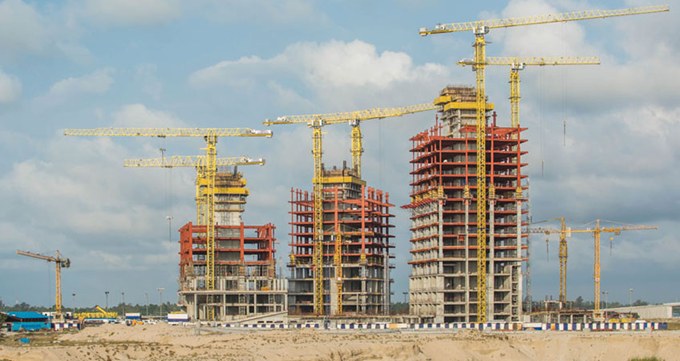
The Lagos Government has announced that obtaining an Environmental Impact Assessment (EIA) approval is a must for all projects developements across the state. The Special Adviser on Environment, Olakunle Rotimi -Akodu, made this known during a Stakeholders’ Engagement on Environmental Impact Assessment (EIA) for Practitioners in Real Estate Sector And Projects Developers in Lagos State held Ikeja, Lagos.”Read Original/For More…Read D Full Story Here Now.”
According to him, all developers and builders must subject their projects to EIA process before its commencement.
Rotimi-Akodu explained that Estate development building projects include 5-floors building and above, 8 apartments units and above, shopping malls, filling stations, industrial facilities, sand mining projects, dredging, land reclamation amongst others, must be approved before the structures begin to take shape...READ FULL; FROM THE SOURCE.
He said the Lagos State Government will not hesitate to enforce compliance in the overriding interest of ensuring public safety and sustainable development when necessary.
The special adviser emphasise that EIA is a critical environmental management tool that must be embraced by both private and public sector (Stakeholders in Real Estate Sector) in order to achieve sustainable development.
According to him, Lagos State has remained the most preferred destination for investors/ businesses in Nigeria, saying this has attributed to the growing population which provides a huge market for goods and services; modern infrastructure as well as sound policies which have continued to create enabling environment for businesses to thrive.
He explained that the establishment of industrial facilities, creation of new settlements, real estate induced coastal reclamation, development of estates, all come with significant adverse environmental impacts ranging from pollution of various environment sources(air, land and water) to sometimes irreversible environmental degradation if not properly managed.
He said the government is determined to continually protect the environment and public health and as such adopted the EIA process as a critical tool for safeguarding the environment and ensure sustainable development in line with global best practices.
The said EIA is a formal process for identifying the likely impacts that may arise from a proposed activity or project on the environment, human health and socio-economic activities adding that it helps in identifying the likely adverse and beneficial impacts of a project with the aim of putting in place measures to reduce or mitigate the adverse ones.
The Special Adviser added that the cost of everyone folding their hands and watch development activities degrade the environment as well as destroy the fragile ecosystem is huge and the State cannot afford this cost in the face of other critical needs.
He reiterated that real estate and the construction industry contribute substantially to the state’s GDP, create thousands of jobs, from Project development as well as architects, engineers, artisans, construction materials suppliers, facility managers amongst others.
Also speaking is the Permanent Secretary, Office Environmental Services, Tajudeen Gaji, who noted that the Workshop is not only apt, but timely, coming at a time when all hands must be on deck to ensure sustainable development in the State.
“EIA is a critical safeguard instrument that has been adopted across the globe as a tool for protecting the environment and public health.
It has as its objective, early identification of likely impacts both adverse and beneficial that could result from a proposed project and proffering appropriate measures to either eliminate, reduce or mitigate the adverse impacts.”
He emphasized that there is no doubt that while projects development come with obvious benefits, they also bring along with them negative environmental and social impacts that must be effectively mitigated or managed.
He said if everyone ignore these impacts, they would expose the already fragile ecosystem of the State to further degradation and by extension jeopardize public health and safety.
The Director Environmental Assessment Department, Olasunkanmi Sojinu, in his lecture mentioned that the EIA process is backed by the EIA Act CAP E12 LFN 2004 and the Lagos State Environmental Management and protection Law 2017 which makes it mandatory for all major developments to subject such to the EIA process and obtain appropriate approval before commencement.
He said the the principles of EIA include participatory which involve all relevant stakeholders including members of the public, project host communities and other interested parties in the ElA process as well as proportionality which is the level of details or scope of the EIA that match the size of the project and potential significant impacts of the project amongst others.
BREAKING NEWS: Will The Court Accept Such Case?? Video Goes Viral After Man Sues His Wife For Taking Away Their Daughter From Him Because He Planned of Marrying His Daughter.
FOR MORE INFO, FINALIZE & FINISH YOUR READING HERE
Do you want to easily get our latest news fast? kindly follow our Whats-app Channel via this Link Here Now.
Disclaimer: This content, including any advice provided, is for general informational purposes only and should not be considered a substitute for professional medical advice. Always seek guidance from a qualified healthcare professional or your doctor for proper evaluation and treatment. Naijacoaded.com does not accept any responsibility for the use of this information.