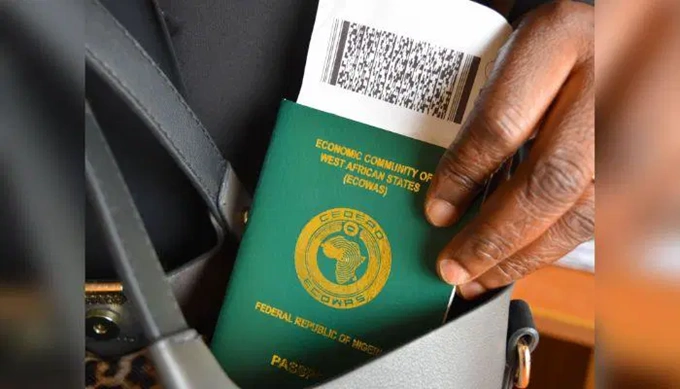
Nigeria has been caught in the jaws of inflation over the last two years. Nigerians are basically struggling to stay afloat in the ocean of high inflation precipitated by recent government policies. And just when the Nigerian Bureau of Statistics was talking of a stable economy, another federal agency is adding to the financial pressure. Yes, the cost of a Nigerian passport has been significantly increased, placing a further burden on citizens grappling with a harsh economic climate.Read Original/For More…Read D Full Story Here Now.”..READ FULL; FROM THE SOURCE.
On August 28, 2025, the Nigeria Immigration Service, NIS, unveiled a wave of financial burden for citizens. From Monday, September 1, 2025, the cost of acquiring a 32-page passport (valid for five years) rose from N50,000 to N100,000, while the 64-page passport (valid for ten years) jumped from N100,000 to N200,000, a staggering 100 per cent increase across the board. Applicants in the diaspora are spared this hike, with fees remaining at US $150 and US $230, respectively.
This move is especially insensitive because it marks the second significant increase within a year. In September 2024, passport fees were already raised: 32-page passports moving from N35,000 to N50,000, and 64-page passports from N70,000 to N100,000, triggering widespread public discontent. Despite government’s assurances that fee hikes are necessary for maintaining quality and upholding the integrity of the document, the near doubling of fees in under 12 months raises serious questions.
Why is the government increasing passport fees again so soon after a previous hike? What specific factors justify a near doubling of fees in less than a year? What does “maintaining quality and integrity” of the passport mean in practical terms, and how does the fee increase directly contribute to this? How will the new fees impact ordinary citizens, particularly those with low incomes? How does this increase align with government’s broader economic policies, especially as citizens deal with high inflation?
For millions of Nigerians, this surge arrives against a backdrop of persistent economic hardship, skyrocketing inflation, high unemployment, dwindling purchasing power, and cost-of-living pressures. Travel, already privileged, becomes nearly exorbitant. A 10-year passport now costing N200,000 is likely beyond the reach of middle- and lower-income earners, effectively creating new barriers to mobility, for work, education, medical care, or reunions with loved ones abroad.
NIS defends its decision, citing needs such as improving production quality, safeguarding passport integrity, and enhancing service delivery, claims echoed during the 2024 hike. But when citizens have already endured a massive hike last year, the sudden doubling again within months smacks of fiscal recklessness. Without transparency into the actual costs or targeted improvements, these justifications ring hollow.
It’s notable, and arguably inequitable, that while internal applicants face steep increases, diaspora fees remain unchanged at fixed dollar amounts. Government defends this on exchange-rate stability grounds, citing dollar-denominated production costs, but that reasoning only underscores the suffering of Nigerians in-country, grappling with currency devaluation. It also draws attention to structural inequities between those abroad and those at home.
The timing of this hike, almost exactly one year after the previous increase, suggests a pattern of frequent, steep surcharges rather than long-term financial planning or gradual scaling. This approach undermines public trust. Citizens deserve predictable, transparent policymaking, not shock increases that further degrade confidence in public institutions.
This sudden cost increase is unacceptable. To my mind, here are four things that the NIS must do quickly to assure Nigerians that its purpose is not strictly to ‘obtain’ Nigerians.
Number one, it must offer a transparent cost breakdown. NIS should publish clear accounts showing why fees need to increase, and how additional revenue will be utilised, be it improved printing technology, staff training, or office expansion.
Two, these sorts of price adjustments should be gradual. The case here is that, rather than raising fees in large leaps, the government should pursue incremental adjustments aligned with inflation and real cost growth.
Besides, the service needs to deploy means-based considerations. It has to offer concessions or instalment options for civil servants, students, and low-income applicants to avoid penalising the most vulnerable.
Lastly, the increase must lead to genuine service improvements. The NIS has a responsibility to ensure that any increased revenue translates into tangible improvements. This is in terms of faster processing, functional local centres, and expanded access, including to rural areas.
My argument is that the decision by the Nigeria Immigration Service to double passport fees again within a year reflects a tone-deaf disregard for the economic realities Nigerians face today. Without transparency or clear, citizen-centred outcomes, this move risks deepening distrust and entrenching inequality. If passports, tools for personal advancement and global mobility, become prohibitively expensive, what message does that send about who truly belongs in the conversation of African opportunity?
Let this be a call for accountability, compassion, and reform, not further financial burden under the guise of progress.
BREAKING NEWS: Will The Court Accept Such Case?? Video Goes Viral After Man Sues His Wife For Taking Away Their Daughter From Him Because He Planned of Marrying His Daughter.
Do you want to easily get our latest news fast? kindly follow our Whats-app Channel via this Link Here Now.
Copyright 2026 Naijacoaded. All rights reserved. This material, and other digital content on this website, may not be reproduced, published, broadcast, rewritten or redistributed in whole or in part without prior express written permission from Naijacoaded.