BREAKING NEWS: Did You Miss The 400 $ex T4pe of Equatorial Guinea senior official Baltasar Ebang Engonga? Quickly W4tch! Before They Are deleted Be The First Person To See The Full Videos. Now!
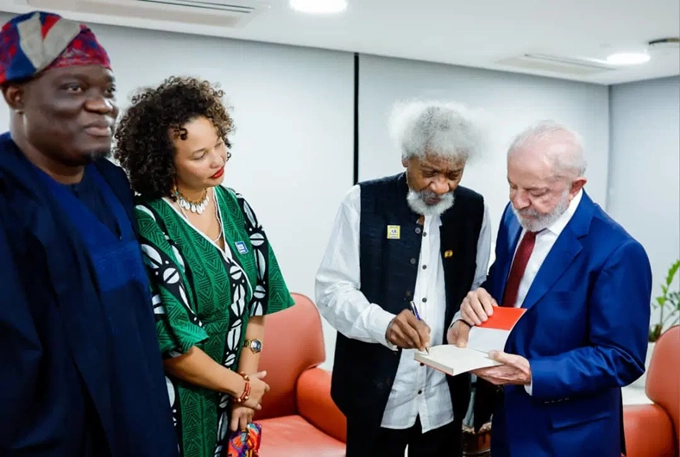
It was an epoch making occasion when the Brazilian President Luiz Inácio Lula da Silva in company of President Bola Ahmed Tinubu recently met with the Nobel Laureate Professor Wole Soyinka, the coordinators of the Heritage Voyage of Return (HVR) Project, Ajoyemi Osunleye and Carolina Morais at the Legislative Chamber of Federal District of Brasilia, Brazil. It was to inform the Brazilian president about the Heritage Voyage Return (HVR) a reverse slave trade route project aimed at reconnecting the Diaspora with Africa, with Brazil as the takeoff point.
The meeting between the two world leaders and the Noble Laureates showcased the deep ancestral ties, shared dreams and vision between Brazil and Nigeria. Professor Soyinka later had a private meeting with President Lula...READ FULL; FROM THE SOURCE.
The champions of the HVR Project, Ajoyemi Osunleye and Carolina Morais, explained that the project was to consolidate on the ties between Brazil and Nigeria, and by extension Africa with Brazil, using culture, art, and history to build bridges of understanding.
My savings for prosthetic leg keep decreasing – Ifeoluwa, sole accident survivor
0:00 / 1:00
President Lula, visibly moved, pledged his support to advancing the HVR Project, affirming Brazil’s commitment to celebrating the shared heritage that unites the two nations.
Apart of the endorsement of the HVR project by President Lula, the meeting highlight also showcased President Tinubu’s humility, President Lula’s reverence, and Prof. Wole Soyinka’s enduring presence even at 91 years which together wove a narrative of respect, unity, and cultural pride. President Lula watched as the Nigeria President show respect and humility by standing up to offer his seat to Professor Soyinka and called him ‘egbon’, elder brother.
It was a testament to ancestral bonds, to the strength of cultural diplomacy, and to the power of leaders who embody humility and humanity. In the words of one observer, “The grace on Soyinka became the grace on us all.”
BREAKING NEWS: Did You Miss The 400 $ex T4pe of Equatorial Guinea senior official Baltasar Ebang Engonga? Quickly W4tch! Before They Are deleted Be The First Person To See The Full Videos. Now!
After his private audience with Brazilian President, Prof. Wole Soyinka joined Nigeria’s Central Bank Governor, Mr. Yemi Cardoso, who is an Afro-Brazilian descendant for a historic session at the Legislative Chamber of the Federal District in Brazil. The warm reception, attended by Brazilian lawmakers and Afro-Brazilian leaders, was described by many as a “homecoming” — a symbolic re-connection between Brazil and Nigeria, two nations bound by deep ancestral and cultural ties.
Representing President Bola Ahmed Tinubu, Cardoso formally presented the Heritage Voyage of Return (HVR) Project to the Brazilian Parliament. In his address, Cardoso highlighted the shared heritage of both nations and the unique opportunity for renewed collaboration. “The commitment between the leadership of President Lula and President Tinubu is unprecedented,” Cardoso declared. “Both leaders are aligned in vision, and we can already see the immense possibilities for cooperation between our countries.”
He went further to reflect on the enduring historical and cultural bonds between Nigeria and Brazil, particularly through Lagos, which hosts a strong Brazilian-descendant community. “In Lagos, we have vibrant Brazilian communities made up of descendants of Africans who returned from Brazil after the era of slavery. These communities have preserved elements of Brazilian culture from cuisine like ‘akara’ to festivals, carnivals, and even architecture. The Brazilian Quarters on Lagos Island remain a living museum of cultural and architectural heritage,” Cardoso emphasized that such connections should form the foundation for a stronger bilateral relationship: “If we cannot seize this opportunity for collaboration now, then we have ourselves to blame. Our shared heritage must be transformed into pathways for cultural diplomacy, creative economy growth, heritage tourism, and education. This is not only an opportunity but a responsibility.”
The session also highlighted the ongoing success of Yoruba studies in Brazil and the celebration of Afro-Brazilian festivals in Nigeria, as living examples of the cultural exchange that continues to bind the two nations. Other prominent members of the Nigerian delegation included Abike Dabiri-Erewa, Chairman of the Nigerians in Diaspora Commission (NIDCOM), and Otunba Ajiboye, head of the National Institute for Cultural Orientation (NICO). Their presence underscored the significance Nigeria attaches to cultural diplomacy and its determination to strengthen ties with Brazil at both governmental and community levels.
President Bola Ahmed Tinubu, Professor Wole Soyinka and the Central Bank Governor Yemi Cardoso were honored with awards by the President of Education and Culture Commission Gabriel Pereira da Cruz. According to Pereira da Cruz, the awards symbolized not just recognition of history, but also a bold step toward a future where shared heritage becomes the foundation of renewed global partnerships.BREAKING NEWS: Did You Miss The 400 $ex T4pe of Equatorial Guinea senior official Baltasar Ebang Engonga? Quickly W4tch! Before They Are deleted Be The First Person To See The Full Videos. Now!
FOR MORE INFO, FINALIZE & FINISH YOUR READING HERE
Do you want to easily get our latest news fast? kindly follow our Whats-app Channel via this Link Here Now.
Disclaimer: This content, including any advice provided, is for general informational purposes only and should not be considered a substitute for professional medical advice. Always seek guidance from a qualified healthcare professional or your doctor for proper evaluation and treatment. Naijacoaded.com does not accept any responsibility for the use of this information.