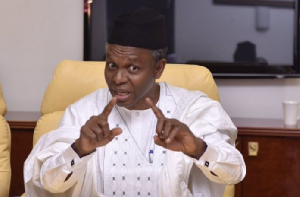
Former Kaduna State Governor, Mallam Nasir El-Rufai, is facing backlash over his claim that the phone of the National Security Adviser, Nuhu Ribadu, was bugged.
Aides of the President and politicians, including former Kano State governor, Abdullahi Ganduje, as well as legal practitioners and security experts, called for El-Rufai’s probe over the claim, arguing that his confession on national television was sufficient grounds for prosecution.
El-Rufai, who appeared on Arise TV on Friday, disclosed that he learnt of an alleged plan to arrest him upon his return to the country on Thursday through a leaked conversation from the NSA’s phone.
“Ribadu made the call because we listened to their calls. The government thinks that they’re the only ones that listen to calls. But we also have our ways. He made the call. He gave the order that they should arrest me.
“That technically is illegal. I know, but the government does it all the time. They listen to our calls all the time without a court order. But someone tapped his phone and told us that he gave the order,” he said.
His disclosure has since triggered concerns within political and security circles, with analysts warning that, if substantiated, the interception could amount to a grave breach of national security protocol and further inflame political tension ahead of the 2027 general elections.
The Special Adviser to the President on Information and Strategy and the Senior Special Assistant to the President on Media and Publicity, Bayo Onanuga and Temitope Ajayi, respectively, responded to El-Rufai’s claim on their social media handles.
Onanuga, in a tweet on his X handle on Friday night, wrote, “El-Rufai confesses to wire-tapping Nigeria’s NSA on TV. Does it mean that he and his collaborators have wire-tapping facilities? This should be thoroughly investigated and punishment meted out. El-Rufai is not too big to face the wrath of the law.”
Ajayi, on the other hand, posted, “El-Rufai admitted on national television that someone tapped the phone of the NSA for him to listen to his conversation. When Charles Aniagolu, the interviewer, interjected that that was an illegal action, El-Rufai agreed to the illegality. By the time he is picked up to produce the person who illegally tapped the NSA’s phone, he would say President Tinubu is a ‘tyrant’ and persecuting him.”
Reacting, a retired Director of the Department of State Services, Abdulrasaq Salami, described the former governor’s statement as “extremely grave.”
He said tapping the NSA’s phone was a breach of national security protocol that required investigation.
“A confirmed admission that the NSA’s phone was tapped would be a grave breach of national security protocol and could trigger criminal probes and forensics across Nigeria’s intelligence architecture.
“This is not an ordinary political scandal. Intercepting the communications of the National Security Adviser, the country’s top security policy official potentially exposes operational plans, sources and methods.
“It undermines the confidentiality on which intelligence and crisis responses depend. If the admission is true, it amounts to a serious breach of national security protocols and requires criminal and administrative investigation,” he said.
According to him, the matter must not be reduced to political drama.
He outlined what he believes should be the immediate institutional response.
“I will call for the immediate suspension of any accounts, credentials or devices believed compromised and order urgent forensics sweep of affected lines and devices. Convene an emergency, classified integrity review chaired by the NSA, including the SSS, NIA, DSS and the Attorney-General. Freeze any routine re-assignment of sensitive tasks until a preliminary damage assessment is complete,” he added.
Also speaking, a retired senior military intelligence officer, who spoke on condition of anonymity, warned that the implications could extend to Nigeria’s international security partnerships.
“Beyond protocol, it risks operational compromise. Intelligence relies on compartmentalisation. Once a senior official’s conversations have been monitored, allies and assets may be endangered and adversaries can exploit exposed patterns. It’s not just unlawful in most circumstances, it is operationally corrosive.”
According to him, the fallout could affect the country’s counter-insurgency collaboration with foreign partners, including the United States.
“Broader implications include damaged international cooperation. Partners may pause intelligence sharing until they are satisfied that sensitive channels are secure.
“Domestically, morale falls and clandestine human sources may withdraw, fearing exposure to a direct hit to prevention and counter-terrorism capacity,” he added.
Technology exists, but it is illegal — Security analyst
However, a security analyst, Kabiru Adamu, told Sunday PUNCH that while the technological capability to intercept high-level communications exists, it is highly restricted.
He said El-Rufai could face a probe if his claim was confirmed to be true.
“The technology to do that is available, but it’s highly sophisticated. Only very few private players have it. It’s usually in the domain of governments or very high-level actors supporting intelligence operations globally,” he said.
Adamu referenced international vendors associated with countries such as Israel, the United Arab Emirates and the United States, noting that such capabilities had operated in Nigeria.
The security expert added that El-Rufai’s statement lends credence to claim that the country’s insecurity challenges were political.
“We’ve always maintained that the weaponisation of security is one of the consequences of the current way the Nigerian political class handles matters.
“On the side of the ruling party, mistakes have been made. The person of the National Security Adviser, who for all intents and purposes, has a political affiliation, has not insulated his office from the political class,” he said.
Adamu further cited concerns about the location of certain government functions within the Office of the National Security Adviser.
“The citing of the Cybercrime Act and Cybercrime Unit within that office creates perceptions. That unit has capabilities that can be used against political opponents.
“El-Rufai has implied those capabilities were used against him. That perception creates tension,” he said.
According to Adamu, if the former governor is invited for questioning, it may be interpreted politically.
“If he’s invited, it will be perceived as political persecution, irrespective of whether the government proves its case or not. There is already enough tension in the country as we approach 2027. Issues like this only escalate it,” he said.
Similarly, a constitutional lawyer, AbdulAzeez Rahman, said unlawful phone tapping remained illegal in the country.
“Section 37 of the 1999 Constitution of the Federal Republic of Nigeria (as amended) guarantees the right of every citizen to privacy of telephone conversations. Section 37 states:
“The privacy of citizens, their homes, correspondence, telephone conversations and telegraphic communications is hereby guaranteed and protected. Section 146(1) of the Nigerian Communications Act, 2003, makes interception unlawful unless backed by lawful authority.
“No person shall intentionally intercept a message sent by means of a public communications network or public communications service except in accordance with a direction issued by a court of competent jurisdiction or as otherwise permitted by law,” he said.
Rahman cited the Lawful Interception of Communications Regulations, 2019, issued under the Nigerian Communications Act, which stipulates that interception must be carried out only by designated law enforcement and security agencies.
The Cybercrime (Prohibition, Prevention, etc.) Act, 2015, also criminalises unlawful interception.
“Any person who, without lawful authority, intercepts by technical means any non-public transmission of computer data commits an offence and is liable on conviction. Penalties include fines and imprisonment,” Rahman explained.
He warned that any evidence obtained through unlawful interception might be inadmissible under the Evidence Act.
Ganduje fires back
Meanwhile, Ganduje also called for El-Rufai’s investigation, after the latter linked him to the disappearance of a Kaduna-based activist, Abubakar Idris, popularly known as Dadiyata.
Ganduje, in a statement on Saturday by a former Kano commissioner for Information and Internal Affairs, Muhammad Garba, described the allegation “as reckless, unfounded and a clear attempt to shift responsibility for an incident that occurred entirely within Kaduna State.”
For several years, many Nigerians on social media accused El-Rufai, who was Kaduna governor during the abduction, of having a hand in the incident.
Addressing the allegations on the Arise Television programme, El-Rufai said Dadiyata was not a critic of his administration as widely speculated.
Instead, he stated that the activist was a vocal critic of Ganduje’s government.
“Three years after he was abducted, a policeman who was posted from Kano to Ekiti State confessed to someone that they were sent from Kano to abduct Dadiyata and that the officer was worried about that. That is all I know,” El-Rufai stated.
However, Garba emphasised that Dadiyata lived and operated in Kaduna, where he was widely known for directing his criticisms at the Kaduna State Government.
According to him, there is no credible record suggesting that the activist’s primary focus was the Kano State Government or Ganduje.
“Everyone in Kaduna knew the nature of the criticism he made and who it was directed at,” he stated, noting that responsibility for security in Kaduna at the time rested with the state government and the relevant federal security agencies operating there.
He called for careful scrutiny of El-Rufai’s recent remarks, stressing that such serious allegations must be supported by verifiable evidence rather than political rhetoric.
“Dragging Ganduje into the matter without proof, Garba said, not only politicises a painful and unresolved episode but also risks further confusing the public over an already sensitive case.
“Contrasting the political climates of both states during the period in question, Garba maintained that Ganduje’s two-term administration in Kano was marked by tolerance for criticism, open media engagement and acceptance of opposition voices,” he said.