
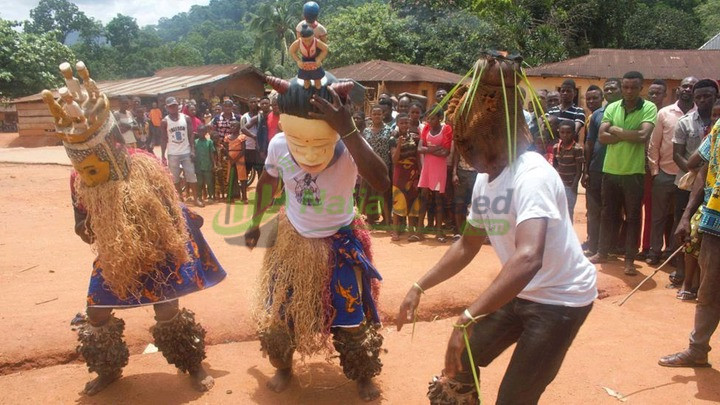
They see this distinctive difference as “a blessing from God,” but as more young people go to countries where English is more widely used and spoken, there are worries that it won’t endure.
Chief Oliver Ibang, sporting a brightly colored traditional dress, a red chief’s headgear, and wielding a staff, summons his two young children and invites them to show off their varied linguistic abilities.
He asks his daughter what it is called while holding up a yam...To Read The Full Content; Tap Here Now .
She says without hesitation, “It’s ‘irui’.”
However, the name for yam, one of Nigeria’s staple foods, is “itong” in the “male language” of the Ubang.
There are numerous other instances as well, such as the terms for clothing, which are “nki” for men and “ariga” for women.
According to research, the sexes communicate effectively but only employ language appropriate to their s£x.
There is no pattern, such as whether the words are often used, related, or connected to conventional roles for men or women, therefore it is unclear exactly what percentage of words in the two languages are different.
According to anthropologist Chi Chi Undie, who has researched the community, “It’s almost like two different lexicons.
There are many words that men and women use interchangeably, but there are also some that are completely different depending on sex. They sound utterly different, don’t share any letters, and are whole different words.
A “mark of maturity”
She claims that there are far more contrasts between the two than, for instance, between British and American English.
But men and women can understand one other just as well as anyone else in the world, if not better.
According to Chief Ibang, males spend the most of their childhoods with their moms and other women, therefore they may grow up speaking the female language.
Boys are expected to speak the “male language” by the age of 10, according to him.
“The man will eventually reach a point when he realizes he is not speaking his proper language. Nobody will advise him to speak in a more masculine manner.
You may tell a person is maturing when they start speaking in “men’s language.”
A child is deemed “abnormal” if they have not transitioned to the right language by a specific age, he claims.
The Ubang people are extremely proud of their distinct language and consider it as a mark of their individuality.
However, there are numerous hypotheses as to how it occurred. The majority of the locals provide a biblical justification.